The Internet of Things (IoT) is changing how devices, machines, buildings, vehicles, and industrial systems communicate. For students enrolling in an IoT course, this subject goes much deeper than smart watches, home assistants, or connected appliances. IoT brings together networking, cloud computing, embedded systems, cybersecurity, automation, analytics, and real-time decision-making.
This introduction to IoT is designed for learners who want more than a surface-level explanation. It gives you a practical overview of IoT by showing how connected systems are planned, built, secured, and used in real environments.
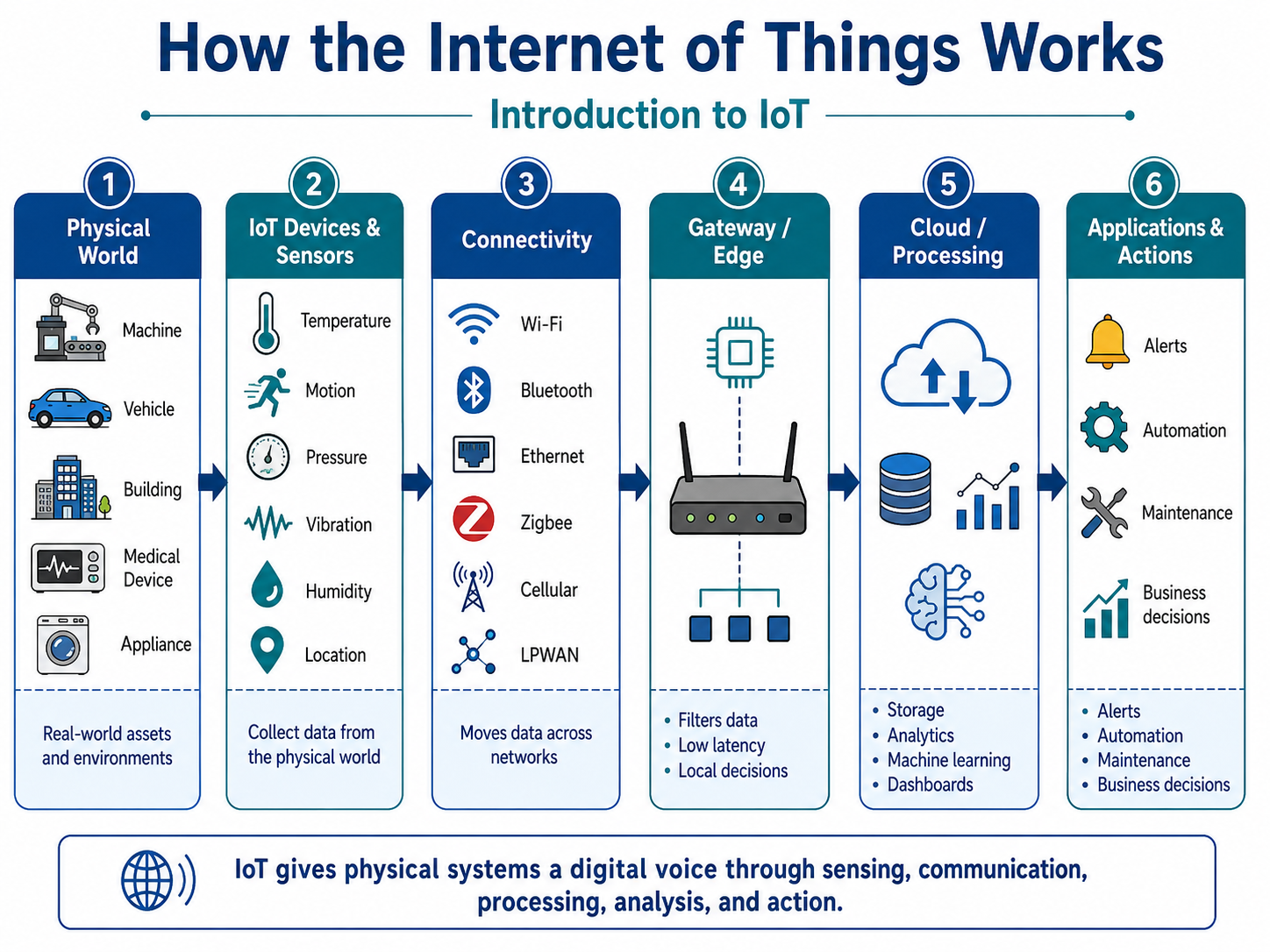
In a modern IoT system, physical devices collect data, networks move that data, processing systems analyze it, and applications turn it into useful action. That action might be a dashboard alert, an automated machine response, a maintenance notification, or a business decision.
What Is the Internet of Things (IoT)?
The Internet of Things refers to a network of physical objects that connect to digital systems so they can collect, exchange, analyze, and act on data. These objects may include sensors, machines, cameras, vehicles, meters, medical devices, appliances, and industrial controllers.
A strong introduction to IoT does not stop at the idea of “connected devices.” The real value of IoT comes from the full cycle of sensing, communication, data processing, analysis, automation, and response.
For example, a connected manufacturing machine can monitor vibration, temperature, energy use, speed, and operating hours. That information can help detect equipment wear, prevent downtime, and improve production planning. In other words, IoT gives physical systems a digital voice.
Key Components of an IoT System
Every IoT system is made of several connected parts. These IoT components work together to capture information, transmit it, process it, and turn it into useful output.
The most important IoT components include devices, sensors, actuators, embedded processors, connectivity modules, gateways, edge platforms, cloud systems, dashboards, and security tools. Each part has a specific job, and the quality of the whole system depends on how well these parts work together.
For students, this section is important because IoT is not one technology. It is a stack of technologies working as one coordinated system.
|
IoT Component |
What It Does |
Why It Matters |
|
IoT Devices |
Connect physical objects to digital systems |
Forms the endpoint of the system |
|
IoT Sensors |
Collect real-world information |
Provides the raw input for decisions |
|
Embedded Processing Units |
Process instructions locally |
Helps devices respond faster |
|
Connectivity Modules |
Move data across networks |
Enables communication between systems |
|
Edge/Cloud Platforms |
Store, analyze, and manage data |
Supports automation and insights |
IoT Devices, Sensors, and Connectivity
IoT devices are the physical endpoints in a connected system. They may be simple, such as a temperature sensor, or advanced, such as an autonomous vehicle, medical monitor, or industrial robot.
These IoT devices usually include sensors, software, communication hardware, and some level of local computing. Their purpose is to collect information from the physical world or perform actions based on instructions.
IoT sensors are especially important because they capture real-world conditions such as motion, humidity, vibration, pressure, light, heat, gas levels, or location. Once this data is captured, it is sent across a network using technologies such as Wi-Fi, Bluetooth, Ethernet, Zigbee, cellular, or LPWAN.
Students who want to strengthen this side of IoT can explore Ascend Education’s guide on networking fundamentals for connected devices.
Embedded Processing Units and Data Processing
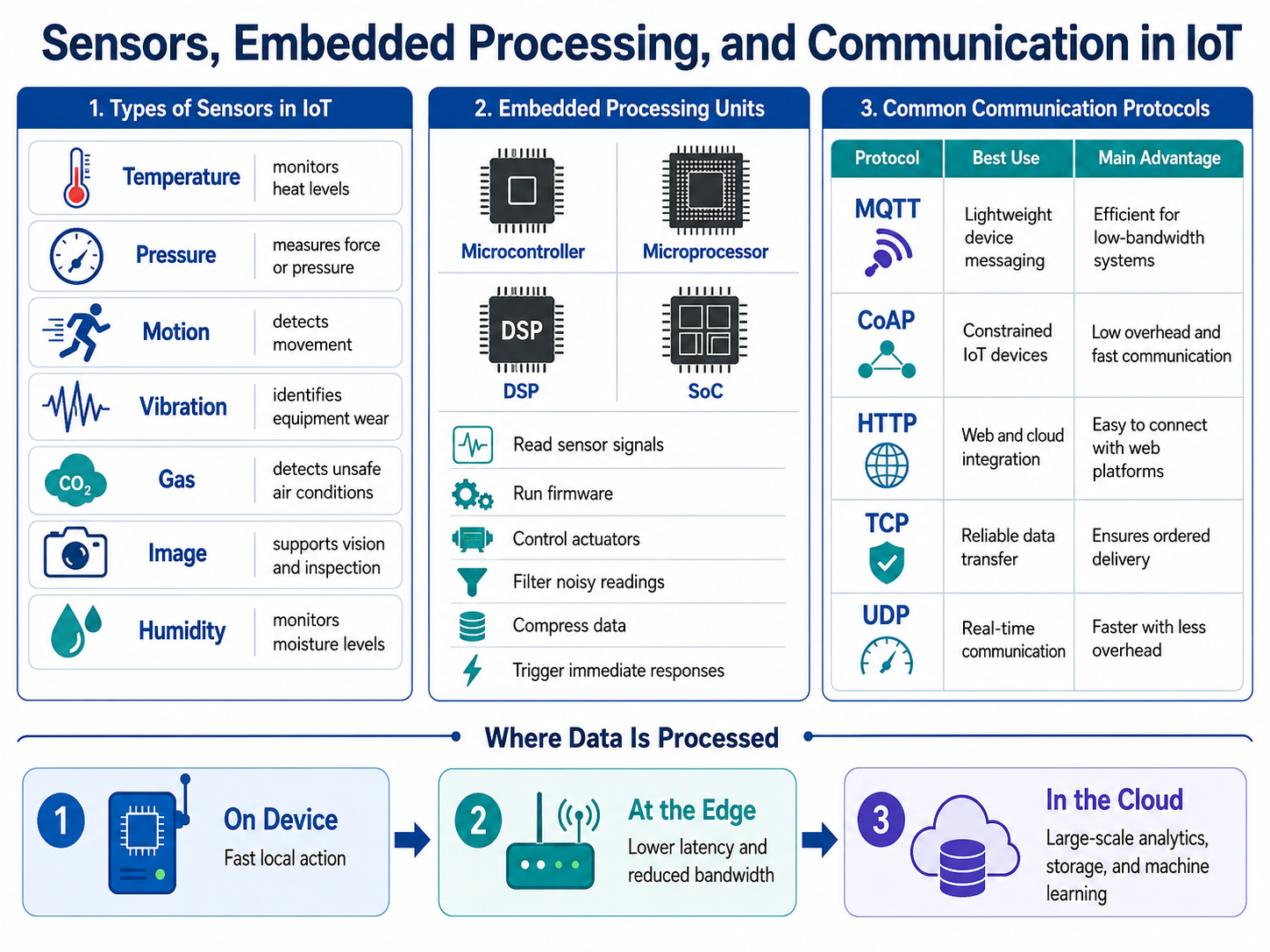
Embedded Processing Units are the small computing engines inside many connected devices. These may include microcontrollers, microprocessors, digital signal processors, or system-on-chip platforms.
Their job is to read sensor signals, run firmware, control actuators, manage communication, and support local decision-making. In advanced systems, Embedded Processing Units may also filter noisy readings, compress information, apply rules, or trigger immediate responses.
This is where data processing becomes a core concept. In an IoT system, data may be processed on the device, at the edge, or in the cloud. Device-level processing supports fast local action. Edge-level processing reduces latency and bandwidth use. Cloud-level processing supports large-scale analytics, storage, dashboards, and machine learning.
Understanding IoT Architecture
IoT Architecture explains how devices, networks, processing systems, applications, and security controls are organized. Without a clear architecture, an IoT project can become slow, insecure, expensive, or difficult to scale.
In an IoT course, students learn that architecture is not just a diagram. It affects performance, reliability, cost, response time, security, and long-term maintenance.
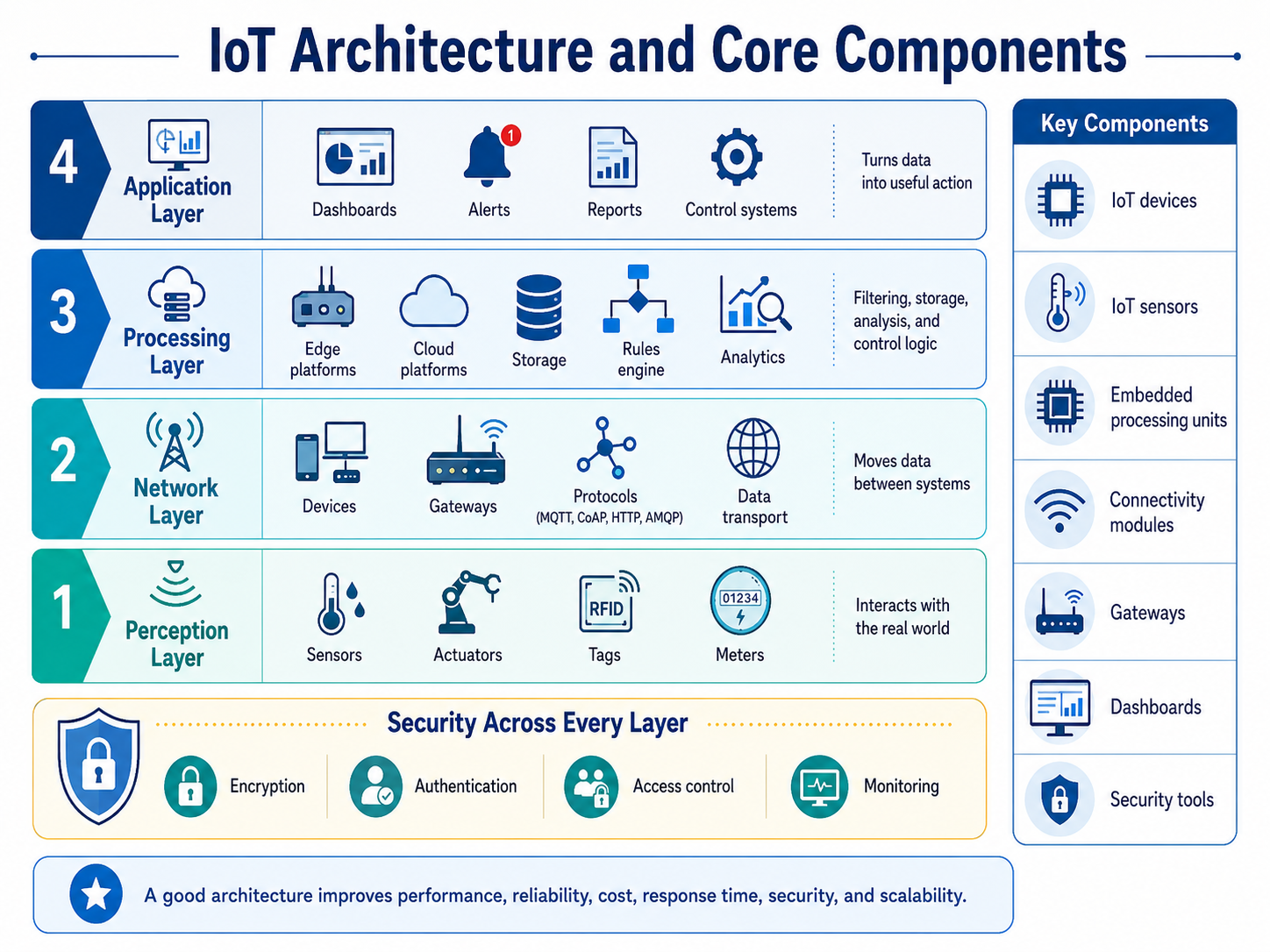
A typical IoT Architecture moves data from the physical environment to a device, through a network, into a processing layer, and then into an application where users or systems can act on it.
Layers and Functions in IoT Architecture
Most IoT Architecture models include several core layers. The perception layer includes sensors, actuators, tags, meters, and physical interfaces. This is where the system interacts with the real world.
The network layer moves data between devices, gateways, edge systems, and cloud platforms. The processing layer handles filtering, storage, analysis, and rule-based logic. The application layer presents the results through dashboards, alerts, reports, or control systems.
Security must also be considered across every layer. A weak device, unsecured network, or poorly protected application can expose the entire system.
Edge Computing and Real-Time IoT Processing
Edge Computing is one of the most important areas in modern IoT. Instead of sending every piece of information to the cloud, Edge Computing allows data to be processed closer to where it is created.
This matters when systems need fast action. A factory safety system, autonomous vehicle, healthcare monitor, or smart traffic controller cannot always wait for a cloud response. With Edge Computing, important decisions can happen near the device.
Edge Computing also reduces bandwidth use. Rather than sending every raw sensor reading to the cloud, the edge system can filter the information and only send alerts, summaries, or meaningful events.
For deeper learning, Ascend Education’s article on edge computing in modern IT systems is a strong next step.
Role of Sensors in IoT Systems
The Role of Sensors in IoT is to convert real-world conditions into digital information. Sensors are what allow connected systems to understand what is happening around them.
The Role of Sensors in IoT is especially important in manufacturing, healthcare, agriculture, transportation, logistics, and smart infrastructure. A sensor reading can show that a machine is overheating, a shipment is too warm, soil moisture is too low, or a patient’s health metric has changed.
From a course perspective, the Role of Sensors in IoT helps students understand how hardware choices affect accuracy, response time, reliability, power use, and system cost.
Types of Sensors in IoT and Their Applications
The Types of Sensors in IoT depend on the use case. A smart building, connected vehicle, hospital device, and industrial machine all need different sensing capabilities.
Common sensor types include:
- Temperature sensors: These monitor heat levels in rooms, machines, storage units, and medical environments.
- Pressure sensors: These measure force or pressure in industrial, automotive, and fluid systems.
- Motion sensors: These detect movement for security, automation, and occupancy tracking.
- Vibration sensors: These help identify equipment wear or mechanical imbalance.
- Gas sensors: These detect unsafe air conditions, smoke, carbon monoxide, or chemical leaks.
- Image sensors: These support cameras, inspection systems, computer vision, and security tools.
- Humidity sensors: These monitor moisture levels in agriculture, storage, and building systems.
Learning the Types of Sensors in IoT helps students match the right hardware to the right problem. That choice can make or break the reliability of an IoT project.
How Sensors Collect and Transfer Data
IoT sensors collect analog or digital signals from the environment. In many cases, analog readings must be converted into digital values before they can be processed by Embedded Processing Units.
After the signal is collected, the device may clean it, timestamp it, compare it against a threshold, encrypt it, and send it to another system. That system may be a gateway, edge node, cloud platform, or application dashboard.
This is why an overview of IoT must include both hardware and software. Sensors collect the signal, but the larger system decides whether that signal becomes useful information.
How IoT Devices Communicate and Work Together
IoT devices communicate through wired and wireless networks. Some send small packets occasionally, while others stream continuous data. The right communication method depends on distance, power limits, bandwidth, latency, reliability, and security needs.
A wearable device may need low-power wireless communication. A smart factory may rely on wired industrial networks. A remote agriculture sensor may need long-range, low-power connectivity. Each use case requires a different design.
This is where networking knowledge becomes valuable. Students preparing for IoT careers may benefit from CompTIA Network+ certification training because connected systems depend on strong networking fundamentals.
Common IoT Communication Protocols
Common IoT communication protocols include MQTT, CoAP, HTTP, TCP, UDP, Bluetooth Low Energy, Zigbee, LoRaWAN, and cellular IoT technologies.
MQTT is often used because it is lightweight and efficient for devices with limited bandwidth. CoAP works well for constrained devices. HTTP is common when devices connect to web-based services. TCP provides reliable delivery, while UDP supports faster communication where speed matters more than guaranteed delivery.
|
Protocol |
Best Use Case |
Main Advantage |
|
MQTT |
Lightweight device messaging |
Efficient for low-bandwidth systems |
|
CoAP |
Constrained IoT devices |
Low overhead and fast communication |
|
HTTP |
Web and cloud integration |
Easy to connect with web platforms |
|
TCP |
Reliable data transfer |
Ensures ordered delivery |
|
UDP |
Real-time communication |
Faster with less overhead |
Industrial Internet of Things (IIoT) Explained
The industrial Internet of Things applies IoT technology to industrial environments such as factories, warehouses, utilities, energy systems, transportation networks, and production facilities.
Unlike consumer IoT, the industrial Internet of Things often involves higher risk and higher cost. A failed smart speaker is annoying. A failed industrial sensor can create downtime, safety issues, production loss, or equipment damage.
In IIoT environments, connected systems monitor machine health, temperature, vibration, pressure, speed, energy usage, and production quality. This makes the industrial Internet of Things a major area of study for students interested in automation, IT infrastructure, and operations technology.
How IIoT Improves Industrial Automation
The industrial Internet of Things improves automation by connecting machines, sensors, controllers, and analytics platforms. These systems help industrial teams detect issues earlier, reduce manual inspections, and improve uptime.
Predictive maintenance is one of the clearest examples. Instead of waiting for a machine to fail, IIoT systems analyze patterns and warn technicians before a breakdown happens.
The industrial Internet of Things also supports digital twins, remote monitoring, energy optimization, smart supply chains, and machine-to-machine communication.
Real-World Applications of the Internet of Things
A practical introduction to IoT should connect technical concepts to real-world use cases. IoT appears across many industries because organizations want better visibility, smarter automation, and faster decisions.
IoT is commonly used in:
- Healthcare: Connected devices help monitor patients, track equipment, and send alerts when health readings change.
- Agriculture: Smart sensors track soil moisture, weather, irrigation, and crop conditions.
- Transportation: Fleet systems monitor vehicles, routes, fuel use, and cargo status.
- Smart buildings: IoT controls lighting, heating, ventilation, access, and energy use.
- Manufacturing: Connected machines support predictive maintenance, quality control, and automation.
- Utilities: Smart meters and sensors help monitor water, electricity, and infrastructure performance.
Many of these systems also rely on virtualization and cloud computing technologies because IoT data often needs scalable storage, analytics, and remote access.
Benefits and Challenges of IoT Systems
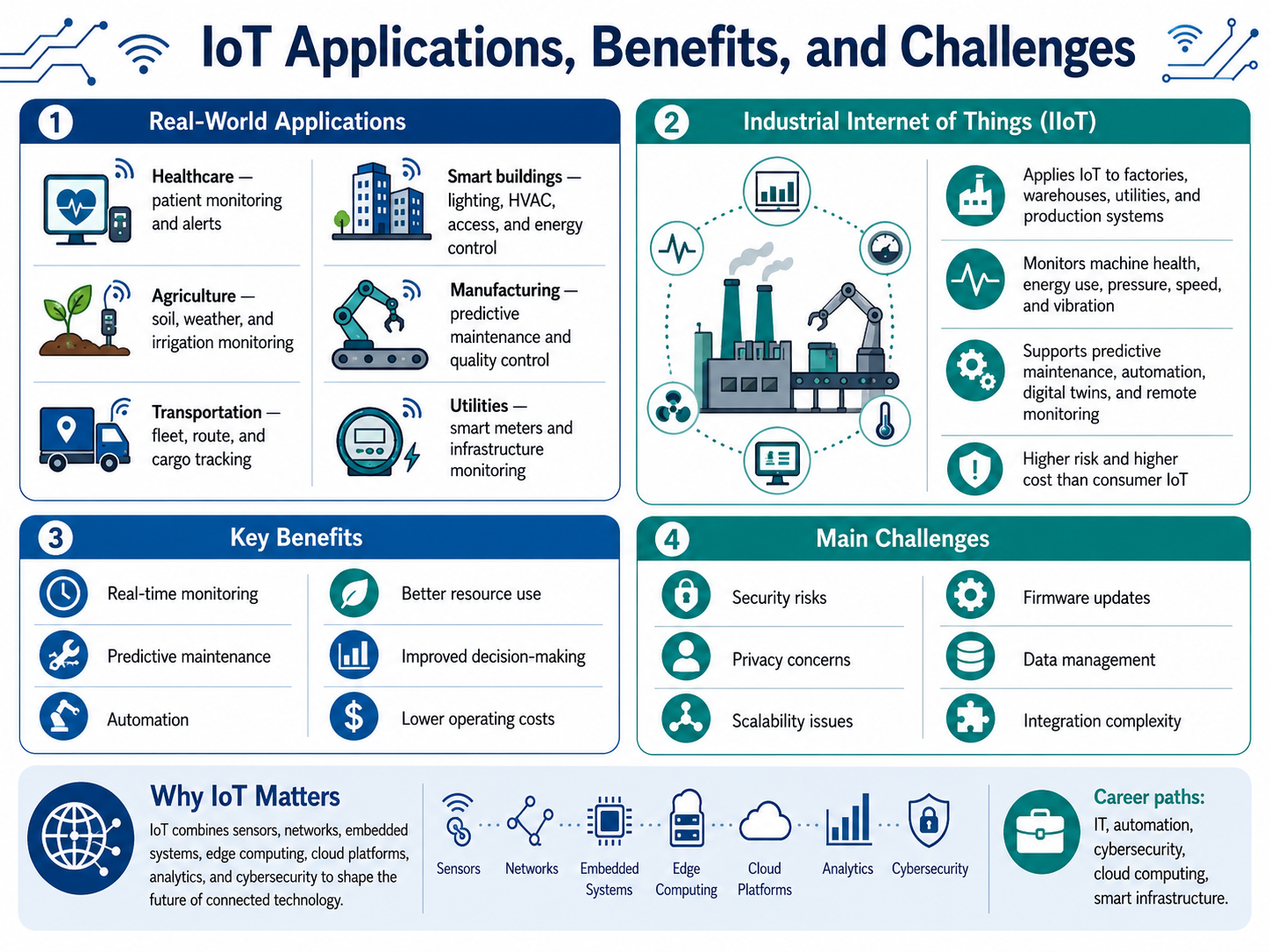
A complete overview of IoT should include both the advantages and the risks. IoT can improve operations, but it also creates new responsibilities.
The benefits are clear. IoT enables automation, real-time monitoring, predictive maintenance, better resource use, improved decision-making, and lower operating costs. It helps organizations move from reactive work to proactive planning.
At the same time, IoT systems can be difficult to manage. More connected devices mean more security risks, more updates, more data, and more integration challenges.
Security, Privacy, and Scalability Challenges
Security is one of the biggest concerns in any IoT system. Every connected device can become a possible attack point. Weak passwords, outdated firmware, insecure APIs, and poor network segmentation can put the whole system at risk.
Privacy is also important. IoT devices may collect location data, health data, user behavior, production data, or environmental readings. Students must understand encryption, access control, authentication, monitoring, and responsible data handling.
Scalability is another major issue. A system that works with 20 devices may not work smoothly with 20,000. As deployments grow, teams need better device management, automated updates, monitoring tools, and efficient data pipelines.
Why IoT Matters in the Future of Technology
This introduction to IoT shows that IoT is not a single tool. It is a complete technology ecosystem built from sensors, networks, embedded systems, cloud platforms, Edge Computing, applications, analytics, and cybersecurity.
For students enrolling in an IoT course, the goal is not just to memorize terms. The goal is to understand how modern connected systems are designed, deployed, secured, and improved.
Professionals who understand IoT Architecture, Embedded Processing Units, Types of Sensors in IoT, Role of Sensors in IoT, networking, and Edge Computing will be better prepared for careers in IT, automation, cybersecurity, cloud computing, manufacturing, and smart infrastructure.
IoT is already shaping healthcare, transportation, agriculture, utilities, smart cities, and industrial automation. Learning it now gives students a stronger foundation for the future of connected technology.
FAQs
What industries use IoT technology the most?
IoT is widely used in manufacturing, healthcare, transportation, logistics, agriculture, energy, utilities, smart buildings, and smart cities.
What is the difference between IoT and IIoT?
IoT is the broader category of connected devices and systems. IIoT, or the industrial Internet of Things, focuses on industrial environments such as factories, utilities, transportation networks, and automation platforms.
Why are embedded processing units important in IoT devices?
Embedded Processing Units allow IoT devices to process sensor data, run firmware, manage communication, control actuators, and respond locally without always depending on the cloud.
How is data processed in an IoT system?
In an IoT system, data can be processed on the device, at the edge, or in the cloud. Device and edge processing support faster responses, while cloud processing supports large-scale analytics, storage, reporting, and machine learning.