CompTIA Security+ SY0 701 Study Roadmap 2026

CompTIA Security+ SY0 701 Study Roadmap 2026

CompTIA Security+ SY0 701 is the current study path for learners preparing for the Security+ exam in 2026. It covers core cybersecurity concepts, threats, vulnerabilities, architecture, operations, risk, governance, and practical security decision-making.


For many learners, the CompTIA Security+ certification is the first serious step toward cybersecurity. It gives IT support professionals, career changers, and early security learners a clear way to build foundational security knowledge.


The challenge is that Security+ can feel broad at first. There are many terms, tools, acronyms, and security scenarios to understand. That is why a structured roadmap helps. It gives learners a clear order for what to study, what to practise, and what to review before exam day.


What Is CompTIA Security+?

CompTIA Security+ is a foundational cybersecurity certification that helps learners understand security concepts, threats, controls, risk, and operations. It is vendor-neutral, so the knowledge applies across different tools, platforms, networks, and business environments.


The certification fits learners who already understand basic IT concepts and want to move toward cybersecurity. For example, IT support professionals may use Security+ to build knowledge in identity, access control, monitoring, network protection, and incident response.


In practice, Security+ helps learners think like security professionals. It does not only test definitions. It also checks whether candidates can understand risks, choose the right controls, respond to scenarios, and apply security logic.


What Is the Current CompTIA Security+ Exam?

The current CompTIA Security+ exam is SY0-701. This version replaced the older SY0-601 exam and reflects newer security priorities across hybrid environments, cloud security, automation, identity, risk, and security operations.


The CompTIA Security+ exam includes multiple-choice questions and Performance-Based Questions, also called PBQs. These questions test both knowledge and applied decision-making, so learners need more than memorised notes.


Before choosing any CompTIA Security+ study guide, learners should check that the material follows SY0-701. Older resources may still explain useful basics, but the main study roadmap should match the current exam objectives.


What Is the Latest CompTIA Security+ Exam?

The latest CompTIA Security+ exam is SY0-701, unless CompTIA releases a newer version or a new objective document. For 2026 preparation, learners should treat the official CompTIA objectives as the main reference point.


This matters because cybersecurity changes quickly. However, a good roadmap should not chase every new trend before covering the exam base. First, learners should understand the official domains. After that, they can connect those topics to current security work.


For example, cloud security, identity protection, incident response, governance, and automation all appear in modern security roles. SY0-701 brings these ideas together into one foundation-level certification.


What Does CompTIA Security+ Cover?

What does CompTIA Security+ cover? It covers five major cybersecurity domains. These domains help learners understand security from basic concepts to real operational tasks.


The exam is broad because cybersecurity work is broad. A security learner may need to identify a threat, choose a mitigation, understand cloud architecture, read a scenario, or recognise a governance issue.


The five domains include General Security Concepts, Threats, Vulnerabilities and Mitigations, Security Architecture, Security Operations, and Security Program Management and Oversight. Together, they create a practical base for early cybersecurity roles.


CompTIA Security+ SY0-701 Exam Domains

The CompTIA Security+ SY0 701 exam domains give learners a clear way to organise study time. Each domain carries a different exam weight, so the roadmap should give more attention to higher-weight areas.


However, exam weight should not be the only deciding factor. General Security Concepts has the lowest percentage, but it builds the vocabulary needed for every other domain. Therefore, learners should study the domains in a logical order, not only by percentage.


The table below shows the domain weight, main coverage, and study priority.


SY0-701 Domain

Exam Weight

What It Covers

Study Priority

General Security Concepts

12%

Security controls, basic security principles, cryptography, identity basics, and core terms

Build first because it supports every other domain

Threats, Vulnerabilities, and Mitigations

22%

Threat actors, attack types, vulnerabilities, malware, social engineering, and mitigation methods

Study early and review often

Security Architecture

18%

Secure design, cloud security, network architecture, resilience, and enterprise security concepts

Focus on scenarios and architecture decisions

Security Operations

28%

Monitoring, incident response, vulnerability management, automation, access management, and operational controls

Highest priority because it carries the largest exam weight

Security Program Management and Oversight

20%

Risk, governance, compliance, policies, audits, third-party risk, and awareness

Important for business and management-style questions

This breakdown gives the study plan a clear structure. Learners should first build the security language, then move into threats, architecture, operations, and governance.


How to Use This CompTIA Security+ Study Guide

A strong CompTIA Security+ study guide should do more than list exam topics. It should help learners decide what to study first, how to practise, and when to start testing exam readiness.


The best approach is to study the exam in layers. First, learners need the basic language of security. After that, they can move into threats, controls, architecture, operations, and risk.


In practice, a useful study plan should include:

  • Official objectives: The roadmap should follow the current SY0-701 exam objectives.
  • Domain-based study: Each exam domain needs dedicated study time.
  • Hands-on practice: Learners should practise logs, access control, vulnerability review, and security scenarios.
  • PBQ preparation: Performance-Based Questions need practical thinking, not only reading.
  • Timed review: Practice exams help build speed, accuracy, and confidence.

This structure keeps preparation focused. It also helps learners avoid a common mistake: watching videos for weeks without checking whether they can actually apply the concepts.


8-Week CompTIA Security+ SY0-701 Study Roadmap

The right timeline depends on background, schedule, and confidence level. However, an 8-week roadmap works well for many learners who already understand basic IT concepts and can study consistently.


This roadmap breaks the CompTIA Security+ SY0-701 exam into weekly focus areas. Each week includes the main concepts, subconcepts, and practice direction, so preparation feels structured instead of random.


Timeline

Main Focus

Concepts and Subconcepts to Cover

What to Practise

Week 1

Security Foundations

CIA triad: Confidentiality, Integrity, Availability; security controls; authentication; authorisation; accountability; non-repudiation; basic cryptography; identity basics

Define key terms, compare control types, and understand how basic security principles apply in real situations

Week 2

Threats and Vulnerabilities

Threat actors; social engineering; phishing; malware; ransomware; insider threats; zero-day vulnerabilities; misconfigurations; supply chain risk; attack surfaces

Identify attack types from scenarios and match threats with basic mitigation methods

Week 3

Mitigation and Access Control

Hardening; patching; secure configuration; least privilege; Multi-Factor Authentication (MFA); Identity and Access Management (IAM); role-based access; privileged access

Choose the right control for a given risk or user access scenario

Week 4

Security Architecture

Secure network design; segmentation; firewalls; Virtual Private Network (VPN); cloud security; hybrid environments; resilience; backup; disaster recovery; data protection

Review diagrams and decide which security architecture choice fits the situation

Week 5

Security Operations

Logging; monitoring; alerting; Security Information and Event Management (SIEM); Endpoint Detection and Response (EDR); vulnerability management; automation; change management

Read security scenarios and decide what action should happen next

Week 6

Incident Response and Risk

Incident response lifecycle; detection; containment; eradication; recovery; lessons learned; risk assessment; Business Continuity Planning (BCP); Disaster Recovery (DR); governance basics

Build response steps for incidents and connect risks with business impact

Week 7

Governance, Compliance, and PBQs

Policies; standards; procedures; audits; third-party risk; compliance; awareness training; Performance-Based Questions (PBQs); scenario-based review

Practise PBQs, review weak domains, and explain why an answer is correct

Week 8

Final Review and Exam Readiness

Timed practice exams; domain review; acronym revision; weak-area correction; exam strategy; question elimination; time management

Take full practice tests, review every missed answer, and revisit high-weight domains

This roadmap gives every domain enough attention without spreading study time too thin. It also leaves time for review, which is where many learners improve the most.


Week 1–2: Build Security Foundations and Threat Awareness

The first two weeks should focus on the language of cybersecurity. Learners should understand the CIA triad, basic security controls, identity concepts, authentication, authorisation, encryption, and common security terms.


After that, the focus should move toward threats and vulnerabilities. This includes phishing, malware, ransomware, insider threats, social engineering, misconfigurations, and attack surfaces.


Key areas to cover include:

  • CIA triad: Confidentiality protects data from unauthorised access, integrity protects accuracy, and availability keeps systems accessible.
  • Authentication vs authorisation: Authentication confirms identity, while authorisation decides what access is allowed.
  • Security controls: Administrative, technical, physical, preventive, detective, and corrective controls.
  • Threat actors: Hackers, insiders, nation-state actors, hacktivists, and organised cybercriminals.
  • Common attacks: Phishing, malware, ransomware, credential attacks, and social engineering.

This stage builds the base for the full CompTIA Security+ exam. Without these concepts, later topics like incident response, security architecture, and governance become harder to understand.


Week 3–4: Study Mitigation, Access Control, and Security Architecture

The next two weeks should focus on how organisations reduce risk. This includes hardening systems, applying patches, configuring access controls, and designing safer environments.


Access control is especially important because many security problems begin with weak identity management. Learners should understand Multi-Factor Authentication, Identity and Access Management, least privilege, and role-based access.


Key areas to cover include:

  • Hardening: Reducing weaknesses in systems, applications, and devices.
  • Patching: Updating software to fix known vulnerabilities.
  • Least privilege: Giving users only the access needed for their role.
  • MFA: Using more than one method to verify identity.
  • IAM: Managing users, roles, permissions, and access policies.
  • VPN: Creating a protected connection over a public network.
  • Network segmentation: Dividing networks to limit the spread of attacks.
  • Cloud security: Protecting cloud-based systems, data, identities, and workloads.

At the same time, learners should begin studying security architecture. This helps connect individual controls to larger system design decisions.


Week 5–6: Focus on Security Operations, Incident Response, and Risk

Security Operations has the highest exam weight, so it needs serious attention. This domain covers the practical work that security teams handle every day, including monitoring, alerting, vulnerability management, and response.


Learners should also understand how security tools support decision-making. For example, a Security Information and Event Management system collects and analyses security logs, while Endpoint Detection and Response tools help detect suspicious activity on devices.


Key areas to cover include:

  • Logging and monitoring: Collecting system activity to detect unusual behaviour.
  • SIEM: Collecting, analysing, and correlating security events.
  • EDR: Detecting and responding to threats on endpoints.
  • Vulnerability management: Finding, prioritising, and fixing weaknesses.
  • Incident response: Detecting, containing, removing, and recovering from security incidents.
  • BCP: Business Continuity Planning, which keeps operations running during disruption.
  • DR: Disaster Recovery, which focuses on restoring systems after failure or attack.
  • Risk assessment: Identifying threats, likelihood, impact, and response options.

This part of the roadmap should include more scenario-based practice. Many exam questions ask what the security team should do next, so learners need to understand order, priority, and impact.


Week 7–8: Practise PBQs, Governance, and Final Exam Strategy

The final two weeks should focus on review, practice, and exam readiness. Learners should not spend this stage only reading more content. Instead, they should test understanding through practice questions and Performance-Based Questions.


Governance and compliance also need proper attention. These topics may feel less technical, but they appear often in security roles because organisations need policies, audits, standards, and risk controls.


Key areas to cover include:

  • PBQs: Practical exam questions that test applied security thinking.
  • Policies and procedures: Written rules that guide security behaviour and response.
  • Compliance: Meeting legal, regulatory, or industry security requirements.
  • Third-party risk: Managing risks linked to vendors, suppliers, and service providers.
  • Security awareness: Training users to recognise and avoid common risks.
  • Practice exams: Timed tests that help build speed and confidence.
  • Weak-area review: Revisiting topics where practice scores are low.
  • Exam strategy: Reading questions carefully and eliminating wrong answers.

By the final week, the goal should be confidence, not perfection. A strong candidate should understand the main domains, recognise common scenarios, manage exam time, and explain why an answer makes sense.


How to Pass the CompTIA Security+ Exam

How to pass the CompTIA Security+ exam depends on three things: understanding the objectives, practising scenario-based questions, and reviewing weak areas consistently.


Learners should avoid treating the exam like a vocabulary test. Definitions help, but Security+ often asks how concepts apply in real situations.


A practical approach includes:

  • Study the official objectives first: This keeps the roadmap aligned with SY0-701.
  • Use domain weights wisely: Spend more time on Security Operations, threats, and risk.
  • Practise PBQs early: Waiting until the final week can create unnecessary pressure.
  • Review missed questions: Mistakes show where the next study session should focus.
  • Connect topics together: Identity, logging, cloud, risk, and incident response often overlap.
  • Take timed tests: Time management matters on exam day.

As a result, the best preparation combines reading, practice questions, hands-on labs, and review. That mix builds both memory and decision-making.


Common Mistakes to Avoid While Studying Security+

Many learners study hard but still feel unsure because the study process lacks structure. This usually happens when preparation depends only on videos or notes.


Security+ preparation works better when learners actively apply the material. For example, reading about incident response helps, but scenario questions test whether the steps are clear.


Common mistakes include:

  • Studying from outdated SY0-601 material without checking SY0-701 changes.
  • Ignoring PBQs until the last few days.
  • Memorising acronyms without understanding use cases.
  • Spending too much time on easy topics and avoiding weak domains.
  • Skipping practice tests or failing to review explanations.
  • Treating governance and risk as less important because they feel less technical.

Avoiding these mistakes can make the roadmap more efficient. It also helps learners feel more prepared when questions use real-world security situations.


What Can I Do With a CompTIA Security+ Cert?

What can I do with a CompTIA Security+ cert? It can support entry-level and early-career pathways in cybersecurity, IT security, security operations, and technical support roles with security responsibilities.


The CompTIA Security+ certification does not guarantee a job by itself. However, it can help show that a learner understands foundational security concepts and can speak the language of cybersecurity.


Possible roles and pathways include:

  • IT support specialist with security responsibilities
  • Help desk technician moving toward security
  • Junior cybersecurity analyst
  • Security operations centre support role
  • Systems administrator with security duties
  • Network support role with security focus
  • Entry-level risk or compliance support role

Over time, learners may use Security+ as a base before moving toward CySA+, PenTest+, cloud security, or other specialised cybersecurity certifications.


Where Security+ Fits in a Cybersecurity Learning Path

Security+ is often a starting point, not the final destination. It helps learners build a broad cybersecurity base before choosing a more specialised path.


For learners comparing options, a Security+ vs CySA+ decision usually depends on career stage. Security+ fits foundational learning, while CySA+ moves deeper into analytics, detection, and response.


Security+ also fits well before broader planning resources such as Popular Cybersecurity Certifications 2026. It gives learners a clearer sense of where foundational security knowledge sits beside cloud, analyst, ethical hacking, and governance-focused certifications.


As cybersecurity changes, newer learning areas also matter. A learner may later explore SecAI+ certification for security and artificial intelligence concepts, or DoD 8140 certification requirements for roles connected to government and defence workforce standards.


Final Thoughts

CompTIA Security+ SY0 701 preparation works best when learners follow a clear roadmap. The exam covers broad security knowledge, but the structure becomes manageable once learners study the domains in the right order.


A good plan should start with security foundations, move into threats and mitigations, then cover architecture, operations, and risk. After that, learners should spend focused time on PBQs, practice tests, and weak areas.


The CompTIA Security+ certification can be a strong first step into cybersecurity because it teaches the language, logic, and decision-making behind security work. For learners building a security career in 2026, SY0-701 is a practical place to start.


FAQS

What is CompTIA Security+?

CompTIA Security+ is a foundational cybersecurity certification covering security concepts, threats, operations, risk, governance, and practical security decision-making.


What is the current CompTIA Security+ exam?

The current CompTIA Security+ exam is SY0-701. Learners should check the official CompTIA objectives before starting preparation.


What is the latest CompTIA Security+ exam?

The latest CompTIA Security+ exam is SY0-701, unless CompTIA releases a newer version.


What does CompTIA Security+ cover?

It covers five areas: General Security Concepts, Threats/Vulnerabilities/Mitigations, Security Architecture, Security Operations, and Security Program Management.


How to pass the CompTIA Security+ exam?

Follow the official objectives, study by domain, practise PBQs, take timed tests, and review weak areas.


What can I do with a CompTIA Security+ cert?

It can support roles in IT support, junior cybersecurity, security operations, systems administration, and network support.

What Is Competency Based Education, and Why Are IT Programs Adopting It?

What is competency-based education? It is a learning approach where progress is based on proven skills, not just time spent in a class. Instead of moving ahead only because a course week is complete, learners move ahead when they can show that they understand and can apply the required competency.


This model is becoming important in IT education because technical careers depend on practical ability. Employers want people who can troubleshoot systems, configure networks, work with cloud tools, understand cybersecurity basics, and solve real problems.


For IT programs, competency-based education creates a stronger link between learning, practice, assessment, and career readiness. It helps learners focus on what they can actually do, not only what they have studied.


What is Competency-Based Education?

What is competency-based education in simple terms? It is an education model built around clear skills, measurable outcomes, and proof of learning.


In a traditional course, the class may move forward after a fixed number of weeks. In competency-based education, the focus shifts to whether the learner has mastered the required skill or concept.


For example, in an IT program, a learner may need to show the ability to configure a secure user account, troubleshoot a network issue, or explain a cloud service model. Progress depends on demonstrating that skill clearly.


This makes the model especially useful for technical fields because knowledge alone is not enough. In practice, IT learners must also show that they can apply that knowledge.


How the Competency-Based Learning Model Works

The competency-based learning model starts by defining what learners should be able to do by the end of a module, course, or program.


These expected outcomes are called competencies. A competency may be a technical skill, a problem-solving ability, or a job-related task that can be measured.


The model usually follows this flow:

  • Define the competency: The program clearly explains the skill or outcome.
  • Teach the concept: Learners study the topic through lessons, videos, reading, or instructor support.
  • Practice the skill: Learners complete labs, exercises, simulations, or projects.
  • Assess performance: The program checks whether the learner can apply the skill correctly.
  • Give feedback: Learners understand what is correct and what needs improvement.
  • Move forward after mastery: Progress happens after the competency is demonstrated.

This approach keeps learning focused. Instead of only asking learners to remember information, it asks them to prove understanding through action.


Principles of Competency-Based Education

The principles of competency-based education are built around clarity, mastery, flexibility, and measurable progress. These principles help make learning more practical and transparent.


In a strong competency-based program, learners should not feel unsure about what is expected. The course should clearly show the skill being taught, how it will be practised, and how success will be measured.


Important principles include:

  • Clear learning outcomes: Learners know what skill or knowledge must be mastered.
  • Mastery before progress: Movement to the next topic happens after understanding is shown.
  • Meaningful assessment: Assessments test application, not only memory.
  • Timely feedback: Learners receive guidance on what to improve.
  • Flexible learning pace: Some learners may move faster, while others may need more practice.
  • Real-world relevance: Skills should connect to practical tasks and career needs.

These principles make the learning process more purposeful. For IT programs, this matters because technical skills must be built step by step.


Competency-Based Education vs Traditional Education

Traditional education and competency-based education can both support learning. However, they use different methods to measure progress.


In traditional education, the course often moves according to a fixed timeline. Learners complete classes, assignments, tests, and projects within a set schedule. This structure works well for many academic subjects, but it may not always show whether a learner can perform a specific technical task.


Competency-based education takes a more skill-focused approach. The main question is not only whether the learner completed the module, but whether the learner can demonstrate the required competency with confidence.


Factor

Traditional Education

Competency-Based Education

Main focus

Course completion and grades

Skill mastery and demonstrated ability

Learning pace

Usually fixed for the full class

Can be more flexible

Progression

Based on time, exams, and assignments

Based on proving competency

Assessment style

Tests, papers, projects, participation

Performance tasks, assessments, labs, projects

Learner role

Follows the course structure

Takes more responsibility for progress

Best fit

Broad academic learning

Skill-based and career-focused learning

This difference is one reason IT programs are adopting the model. Technical education needs clear proof that a learner can perform important tasks, not only complete lessons.


Why IT Programs Are Adopting Competency-Based Education

IT programs are adopting competency-based education because technology roles require practical skills. A learner preparing for cloud, cybersecurity, networking, or support roles needs more than theory.


For example, knowing what multi-factor authentication means is useful. However, being able to explain when to use it, configure it correctly, and understand its security value is far more important.


This model supports IT education in three major ways:

  • It connects learning to real tasks.
  • It supports better preparation for IT certification courses.
  • It helps learners build confidence through repeated practice.

As a result, competency-based education fits well with technical training because it measures ability more clearly.


How Competency-Based Education Supports Hands-On IT Training

Hands-on IT training works well with competency-based education because both focus on doing, not only reading.


In IT, real learning often happens when a concept is applied. For example, a learner may understand cloud storage in theory, but a lab helps show how storage is created, configured, secured, and tested.


This is why hands-on IT training courses often include labs, simulations, projects, and troubleshooting exercises. These activities give learners a practical way to demonstrate competency.


For IT programs, this creates a better learning path. Learners can study a concept, practise it in a controlled environment, receive feedback, and improve before moving ahead.


Student-Centered Learning in Competency-Based Programs

Student-centred learning is another reason competency-based education is useful. The model focuses on what learners need to master, where they need support, and how they can show progress.


A student-centred approach does not mean the program has no structure. Instead, the structure is built around clear outcomes and learner progress.


For example, one learner may understand networking basics quickly but need more time with cybersecurity concepts. Another learner may be strong in theory but may need more lab practice.


Competency-based learning allows space for these differences. It supports learners at different starting points while still keeping the final standard clear.


What a Competency-Based Curriculum Looks Like in IT

A competency-based curriculum is designed around skills and outcomes. In IT programs, this means the curriculum should clearly show what learners need to know and what they need to perform.


This is different from a curriculum that only lists topics. A topic says what will be covered, while a competency explains what the learner should be able to do after learning it.


For example, a cybersecurity module may not only teach password policies. It may also require learners to identify weak passwords, apply access controls, and explain why stronger authentication matters.


The table below shows how this can look in an IT program. Each area connects a technical topic with a practical skill and a clear method of assessment.


IT Area

Possible Competency

How It Can Be Assessed

Networking

Explain IP addressing and troubleshoot basic connectivity

Lab task or troubleshooting activity

Cloud computing

Identify cloud service models and basic cloud use cases

Scenario-based quiz or cloud lab

Cybersecurity

Apply basic security controls to user accounts

Practical security task

IT support

Diagnose common system or user issues

Ticket-based simulation

Systems administration

Manage users, permissions, and basic configurations

Hands-on lab assessment

This kind of curriculum helps connect lessons to workplace tasks. It also makes assessment more meaningful because learners are measured on applied ability.


Competency-Based Learning Examples in IT

Competency-based learning examples in IT are easy to understand because technical work is naturally task-based.


In many IT roles, professionals are expected to solve problems, follow processes, and make decisions based on real situations. That is why examples in this model often include labs, simulations, scenarios, and practical assessments.


Examples include:

  • Cloud computing: Identifying whether a service is IaaS, PaaS, or SaaS and explaining the use case.
  • Cybersecurity: Setting up multi-factor authentication and explaining how it reduces account risk.
  • Networking: Troubleshooting a device that cannot connect to a network.
  • IT support: Responding to a simulated helpdesk ticket and documenting the solution.
  • System administration: Creating user accounts and assigning correct permissions.
  • Software basics: Testing an application feature and reporting an issue clearly.

These examples show why competency-based learning fits IT programs. The learner is not only asked to know the topic but also to apply it in a realistic situation.


Benefits of Competency-Based Education for IT Learners

The benefits of competency-based education are especially clear in IT training because the field values practical ability.


In technology roles, confidence comes from repeated practice. A learner may understand a concept after reading it, but skill develops when that concept is tested through labs, troubleshooting, and applied tasks.


Key benefits include:

  • Better skill clarity: Learners understand exactly what they need to master.
  • More practical confidence: Labs and assessments help connect theory to real tasks.
  • Stronger certification preparation: The model supports concepts tested in many IT certification courses.
  • Flexible learning support: Learners can spend more time on difficult areas.
  • Clearer progress tracking: Competencies make it easier to see what has been mastered.
  • Better job readiness: Learning connects directly to workplace skills.

However, this model works best when competencies are well-designed. If the outcomes are vague, the program can become confusing. Therefore, strong planning is important.


Where Competency-Based Education Helps IT Certification Courses

IT certification courses often test applied understanding. Even when an exam is multiple-choice, the questions may be scenario-based.


For example, a certification learner may need to choose the right security control, identify a cloud model, understand network troubleshooting, or recognise a risk in a given situation.


Competency-based education supports this because it encourages learners to practise skills before assessment. Instead of memorising definitions alone, learners build a stronger understanding of how concepts work.


This is helpful for learners preparing for certifications in cloud computing, cybersecurity, networking, and IT support.


Is Competency-Based Education Right for Every IT Program?

Competency-based education is useful, but it must be designed carefully. IT programs need clear competencies, strong assessments, practical labs, and proper feedback.


If a program only changes the wording but still teaches in the same old way, the model will not work well. The value comes from aligning lessons, practice, assessments, and outcomes.


It is also important to balance flexibility with structure. Learners still need guidance, timelines, instructor support, and a clear path through the program.


When done properly, competency-based education can make IT learning more practical, more measurable, and more connected to career needs.


Final Thoughts

What is competency-based education really about? It is about making learning more focused on skill mastery and practical progress.


For IT programs, this approach makes sense because technology careers depend on what learners can do. Cloud, cybersecurity, networking, and support roles all require applied knowledge, not only completed coursework.


Competency-based education helps connect classroom learning, hands-on IT training, assessments, and job-ready skills. For learners preparing for IT certification courses or technical careers, that connection can make the learning experience more useful and meaningful.

IaaS PaaS SaaS in Cloud Computing Explained

IaaS PaaS SaaS in Cloud Computing Explained

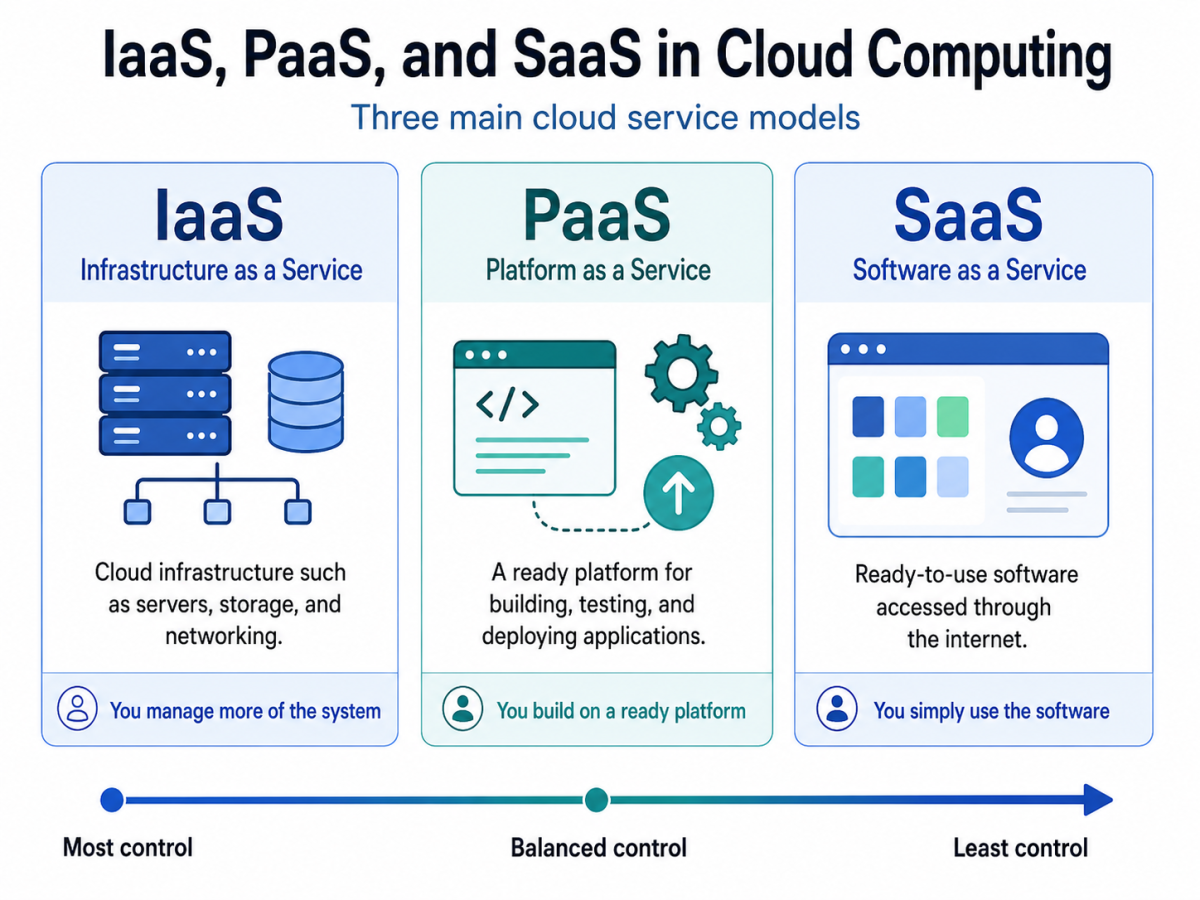
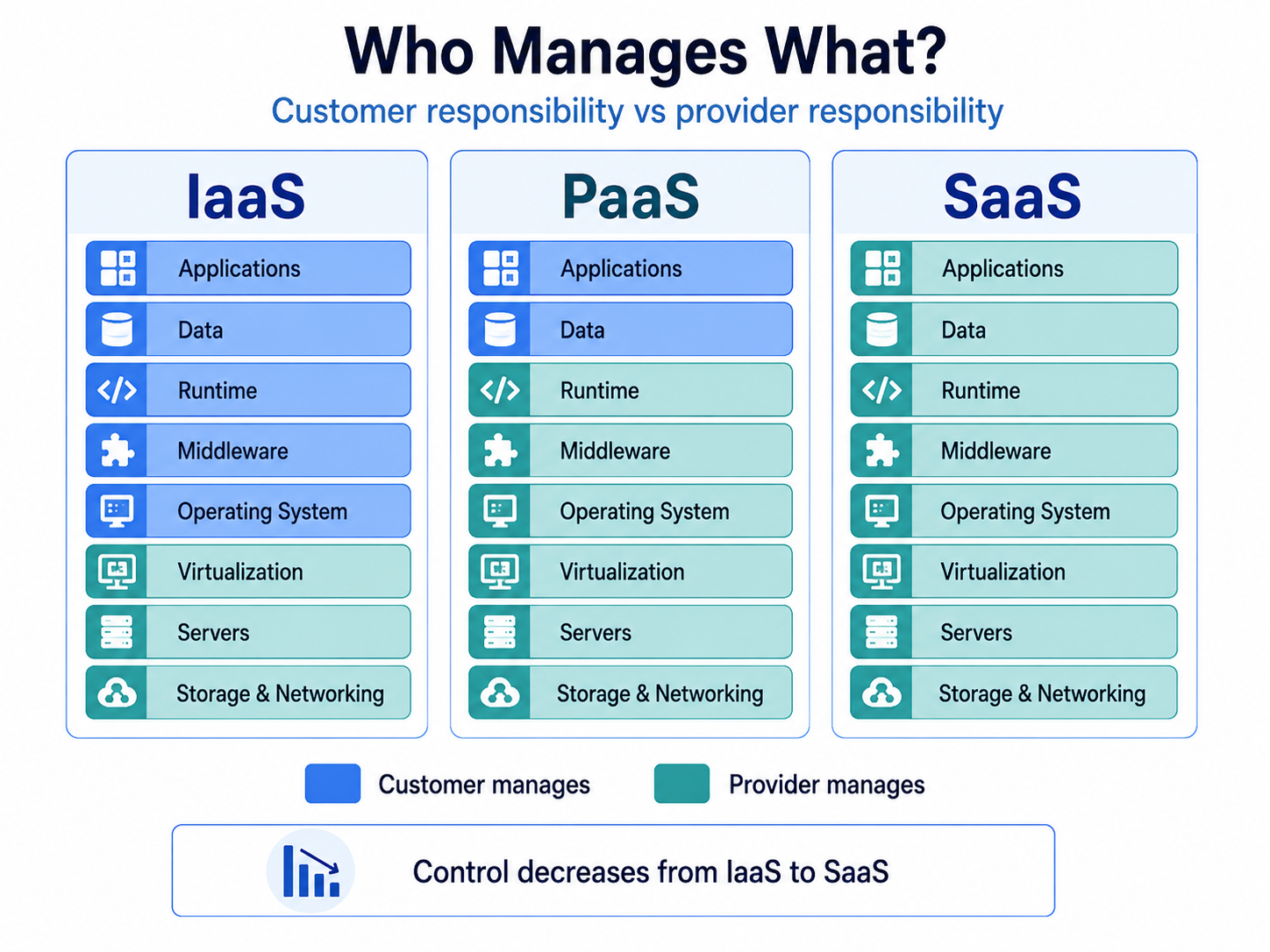
IaaS PaaS SaaS in cloud computing are the three main cloud service models. They explain how much of the technology stack is handled by the cloud provider and how much is managed by the customer.

In simple terms, IaaS gives access to cloud infrastructure, PaaS gives developers a platform to build applications, and SaaS gives users ready-to-use software. These models are important for cloud learners because they appear often in AWS Cloud Practitioner, Azure Fundamentals, and Cloud+ preparation.

Once these models are clear, cloud computing becomes much easier to understand. Learners can see what a cloud provider manages, what the customer manages, and why different businesses choose different cloud service models.

What Are IaaS, PaaS, and SaaS?


IaaS, PaaS, and SaaS are cloud computing service models. A cloud service model explains what type of cloud resource is delivered to the customer.

Instead of buying and maintaining every part of a physical data centre, businesses can use cloud computing to access infrastructure, platforms, and software over the internet. This reduces the need to manage all technology resources in-house.

In simple terms:

  • IaaS gives access to cloud computing infrastructure.
  • PaaS gives developers a platform to build and deploy applications.
  • SaaS gives users software they can access through a browser or app.

This matters because each cloud service model gives a different level of control, flexibility, and responsibility.

What Is IaaS?

IaaS stands for Infrastructure as a Service. It gives businesses access to basic computing resources such as virtual machines, storage, networking, and servers through the cloud.

With IaaS, the cloud provider manages the physical data centres, hardware, networking, and core infrastructure. However, the customer usually manages the operating system, applications, data, runtime, and security settings.

IaaS is useful when a business wants more control without buying physical servers. It supports flexible infrastructure that can be scaled based on demand.

What Is IaaS in Cloud Computing?

IaaS in cloud computing means using infrastructure resources through a cloud provider instead of owning and maintaining them physically. These resources may include compute power, storage, virtual networks, load balancers, and backup systems.

For example, a company that needs servers to host an application can use IaaS cloud resources instead of setting up physical servers in an office or data centre. The company can increase or reduce capacity depending on traffic and workload needs.

Infrastructure as a service in cloud computing is commonly used by businesses that need flexibility, control, and scalability. It is also useful for teams that want to create testing environments quickly without long hardware setup times.

How IaaS Services Are Used

IaaS services are used when organisations need cloud infrastructure but still want control over operating systems, applications, and configurations.

Common uses include:

  • Hosting websites and applications: Businesses can run websites, web apps, and backend systems on virtual servers.
  • Storage and backup: Teams can store files, databases, and backups in the cloud.
  • Testing and development: Developers can create temporary environments without buying new hardware.
  • Disaster recovery: Companies can recover systems faster during outages.
  • Scaling workloads: Resources can be increased or reduced based on demand.

As a result, IaaS works well for organisations that need flexibility but still have the technical skills to manage their environment.

Common IaaS Service Providers

Common IaaS service providers include Amazon Web Services, Microsoft Azure, Google Cloud, IBM Cloud, and Oracle Cloud. These providers offer infrastructure resources such as virtual machines, storage, networking, and cloud security tools.

For example, Amazon EC2 and Azure Virtual Machines are commonly used IaaS examples. Google Cloud infrastructure also provides compute, storage, and networking services that help businesses run workloads in the cloud.

The main point is simple: with IaaS, the provider gives the infrastructure, but the customer still manages many parts of the system.

Advantages and Disadvantages of IaaS in Cloud Computing

The advantages and disadvantages of IaaS in cloud computing depend on how much control and responsibility a business wants.

Advantages of IaaS

Disadvantages of IaaS

High flexibility and control

Requires technical knowledge

Easy to scale resources

Customer manages operating systems and applications

No need to buy physical servers

Security configuration is partly the customer’s responsibility

Useful for testing, hosting, and backup

Costs can increase if resources are not monitored

The benefits of IaaS are strongest when a business needs control over infrastructure. However, it also needs skilled teams to manage systems, security, and costs properly.

What Is PaaS?

PaaS stands for Platform as a Service. It gives developers a ready platform to build, test, deploy, and manage applications without handling most of the underlying infrastructure.

With PaaS, the cloud provider manages servers, storage, networking, operating systems, middleware, and runtime environments. Developers can focus more on writing code and building applications.

In simple terms, PaaS sits between IaaS and SaaS. It gives more support than IaaS but more development control than SaaS.

What Is PaaS in Cloud Computing?

PaaS in cloud computing is a model where developers use a cloud-based platform to create applications. They do not need to manually manage servers, operating systems, or many backend resources.

For example, a development team can build and deploy a web application using a PaaS platform without setting up a server from scratch. The cloud provider handles much of the infrastructure layer in the background.

Platform as a service in cloud computing is especially useful for software development teams. It helps them build faster, test faster, and deploy applications with fewer infrastructure tasks.

How PaaS Services Are Used

PaaS services are mainly used by developers and application teams. They help reduce setup time and make application development more efficient.

Common uses include:

  • Application development: Developers can build and test apps using ready-made tools.
  • Web app deployment: Teams can deploy apps without manually managing servers.
  • Database management: Some PaaS services include managed databases.
  • API development: Developers can create and manage APIs more easily.
  • DevOps workflows: Teams can automate testing, deployment, and updates.

Therefore, PaaS is useful when the goal is to build and launch applications without spending too much time on infrastructure management.

Common PaaS Providers

Common PaaS providers include Microsoft Azure, Google Cloud, AWS, Heroku, Red Hat OpenShift, and Salesforce Platform. These platforms give developers tools to build and deploy applications faster.

Examples include Azure App Service, Google App Engine, AWS Elastic Beanstalk, and Heroku. These services reduce the need to manage servers directly.

However, PaaS does not remove all responsibility. Developers still need to manage code, application logic, data, access controls, and application-level security.

Advantages and Disadvantages of PaaS in Cloud Computing

The advantages and disadvantages of PaaS in cloud computing are closely linked to speed and control.

Advantages of PaaS

Disadvantages of PaaS

Faster application development

Less control over infrastructure

Less server management

Possible platform limitations

Useful developer tools

Vendor lock-in can become a concern

Easier testing and deployment

Custom configurations may be restricted

The benefits of PaaS are strongest for development teams that want to move quickly. However, it may not be the best option when a business needs deep control over the full infrastructure stack.

What Is SaaS?

SaaS stands for Software as a Service. It is a cloud service model where users access ready-to-use software through the internet.

With SaaS, the provider manages almost everything. This includes the infrastructure, platform, application, updates, security patches, and availability. The user mainly manages access, data usage, and basic settings.

SaaS is the easiest model for end users because it does not require server management, platform setup, or software installation.

What Is SaaS in Cloud Computing?

SaaS in cloud computing means software is delivered through the cloud instead of being installed and managed locally on every device.

For example, Gmail, Microsoft 365, Google Workspace, Salesforce, Dropbox, and Zoom are SaaS services. These tools work through the cloud, while the provider manages the backend systems.

Software as a service in cloud computing is common because it is simple, accessible, and easy to scale across teams. It is widely used by businesses, schools, individuals, and enterprises.

How SaaS Services Are Used

SaaS services are used for everyday business and personal tasks. These tools are usually accessed through a browser, mobile app, or desktop app connected to the cloud.

Common uses include:

  • Email and communication: Gmail, Outlook, and Slack.
  • Collaboration: Google Workspace, Microsoft 365, and Notion.
  • Customer relationship management: Salesforce and HubSpot.
  • Video meetings: Zoom and Microsoft Teams.
  • File storage: Dropbox, Google Drive, and OneDrive.
  • Accounting and HR tools: Cloud-based finance and employee management software.

In the same way, many businesses use SaaS cloud tools because they are quick to start and easy to manage.

Common Software as a Service Companies

Common software as a service companies include Microsoft, Google, Salesforce, Adobe, Dropbox, Zoom, Slack, HubSpot, and Shopify.

These companies provide ready-to-use applications that users can access without managing backend infrastructure. For example, Salesforce provides CRM software, Google Workspace provides productivity tools, and Zoom provides video communication software.

For most users, SaaS is the most familiar cloud service model. It is one of the most common examples of cloud computing in daily life.

Advantages and Disadvantages of SaaS in Cloud Computing

The advantages and disadvantages of SaaS in cloud computing are mostly about simplicity, control, cost, and dependency.

Advantages of SaaS

Disadvantages of SaaS

Easy to use and access

Less control over the software

No installation required

Requires internet access

Provider handles updates

Data is stored with the provider

Works well for teams

Customisation may be limited

The benefits of SaaS are strongest when users want convenience and fast access. However, businesses must still think about data privacy, access control, compliance, and vendor dependency.

Difference Between IaaS, PaaS, and SaaS

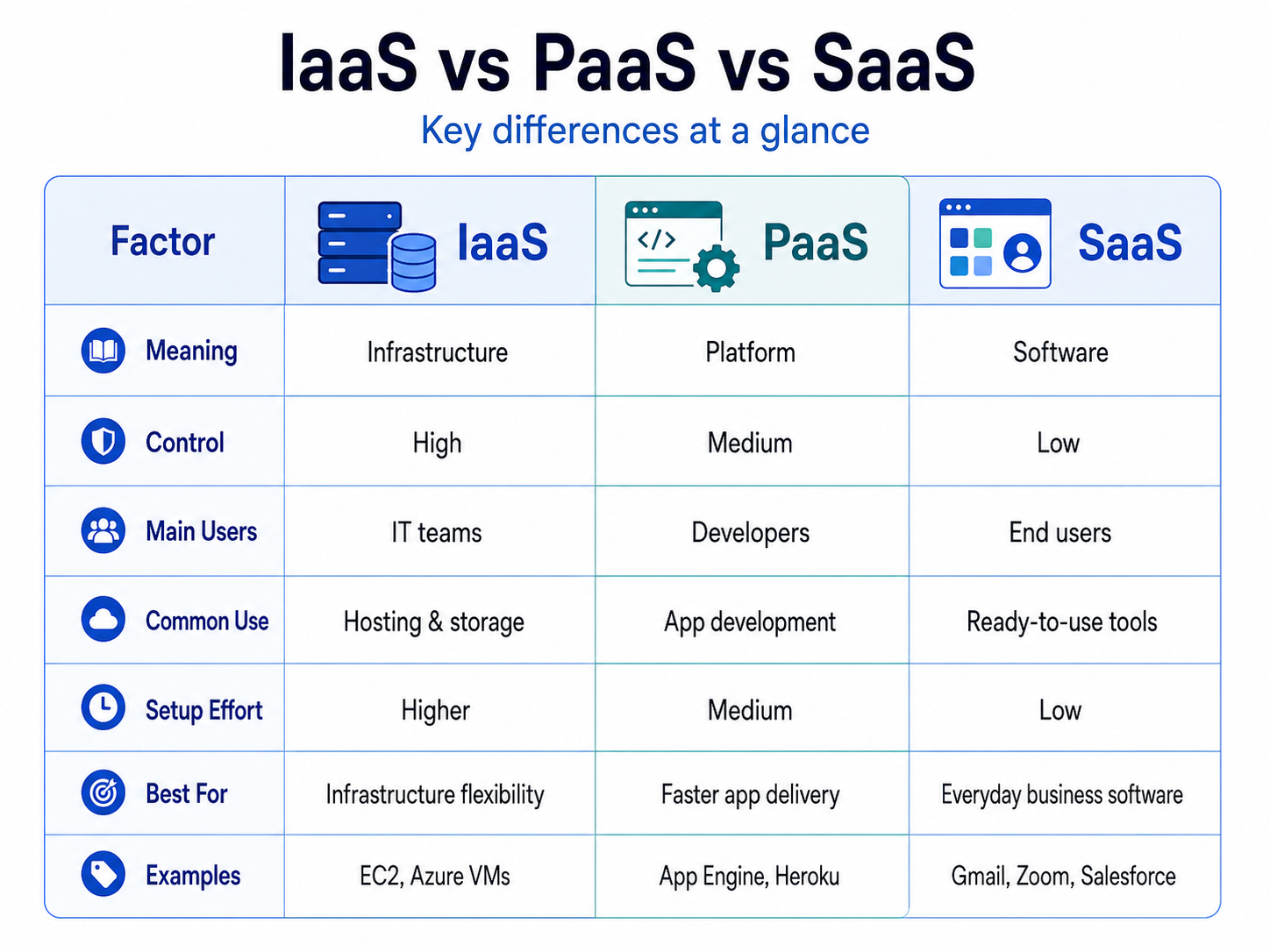
The main difference between IaaS, PaaS, and SaaS is the level of control and responsibility. IaaS gives the customer the most control. SaaS gives the provider the most responsibility. PaaS sits in the middle.

This is why cloud learners should not memorise only definitions. Instead, they should understand what each model gives, who uses it, and what the customer still manages.

Factor

IaaS

PaaS

SaaS

Full Form

Infrastructure as a Service

Platform as a Service

Software as a Service

Basic Meaning

Cloud infrastructure delivered over the internet

Cloud platform for building and deploying applications

Ready-to-use software delivered over the internet

Main Purpose

Provides virtual servers, storage, networking, and infrastructure resources

Provides tools and environments for application development

Provides software that users can access directly

User Control

High

Medium

Low

Ease of Use

Requires technical knowledge

Easier for developers than managing infrastructure

Easiest for end users

Provider Manages

Physical servers, storage, networking, data centres, and virtualisation

Infrastructure, operating system, middleware, runtime, and development environment

Infrastructure, platform, application, updates, security patches, and availability

Customer Manages

Operating system, applications, data, runtime, security settings, and access control

Application code, data, users, access, and application-level settings

User accounts, access permissions, data usage, and basic settings

Main Users

Cloud engineers, system administrators, IT teams, network teams

Developers, DevOps teams, software teams

End users, businesses, students, sales teams, HR teams, marketing teams

Common Use Cases

Hosting websites, running virtual machines, storage, backup, testing, disaster recovery

Building apps, testing apps, deploying web applications, managing APIs, development workflows

Email, CRM, video meetings, file storage, collaboration, project management

Setup Effort

Higher, because teams must configure and manage more

Medium, because the platform is already provided

Low, because the software is ready to use

Customisation Level

High

Medium

Limited compared to IaaS and PaaS

Scalability

Highly scalable, but needs proper setup and monitoring

Scalable for applications and development workloads

Scalable for users, teams, and subscriptions

Security Responsibility

Shared, but the customer has more responsibility

Shared, with the provider managing more of the platform layer

Mostly handled by the provider, but users must manage access and data safely

Cost Pattern

Usually based on infrastructure usage such as compute, storage, and bandwidth

Usually based on platform usage, app resources, or development needs

Usually subscription-based per user, team, or plan

Best For

Businesses that need control over infrastructure

Developers who want to build and deploy apps faster

Users who want software without managing backend systems

Not Ideal For

Non-technical users who only need ready software

Teams that need full infrastructure control

Businesses that need deep backend customisation

Examples

Amazon EC2, Azure Virtual Machines, Google Compute Engine

Azure App Service, Google App Engine, AWS Elastic Beanstalk, Heroku

Gmail, Microsoft 365, Google Workspace, Salesforce, Dropbox, Zoom

Simple Memory Hook

More system management

Build on a ready platform

Use the software directly

In simple terms, IaaS is for managing infrastructure, PaaS is for building applications, and SaaS is for using software.

IaaS, PaaS, and SaaS Examples

IaaS, PaaS, and SaaS examples make the difference easier to understand because each model solves a different cloud need.

Model

Examples

Simple Explanation

IaaS

Amazon EC2, Azure Virtual Machines, Google Compute Engine

Businesses rent cloud infrastructure and manage much of the system themselves.

PaaS

Azure App Service, Google App Engine, AWS Elastic Beanstalk, Heroku

Developers build and deploy apps on a ready platform without managing most infrastructure.

SaaS

Google Workspace, Microsoft 365, Salesforce, Dropbox, Zoom

Users access ready-made software through the cloud.

For example, a company that wants control over servers and storage may choose IaaS. A developer who wants to deploy an app faster may choose PaaS. A team that only needs email, CRM, file sharing, or video meetings can use SaaS.

In simple terms, IaaS supports infrastructure, PaaS supports application development, and SaaS supports direct software usage.

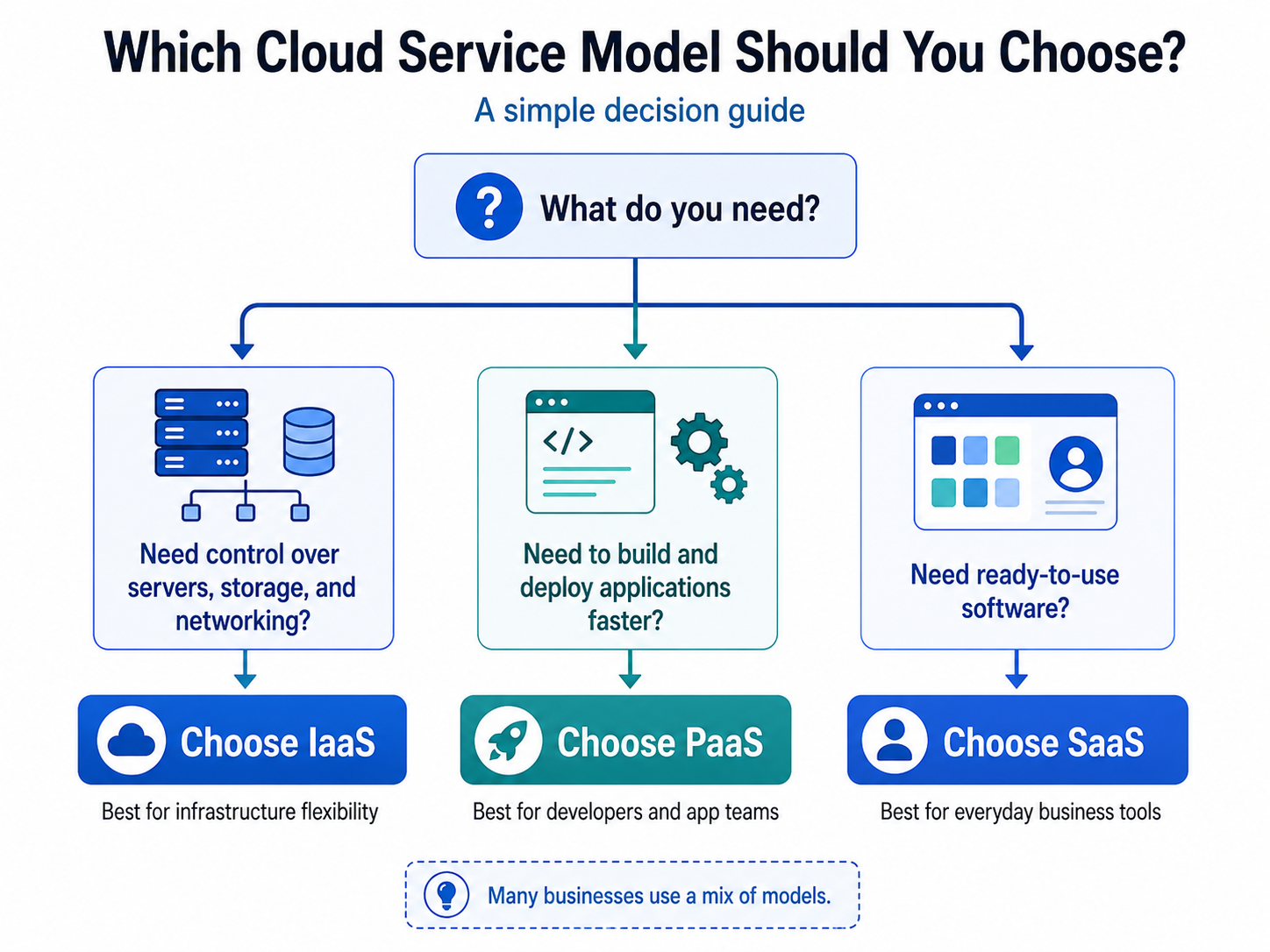
Which Cloud Service Model Should You Choose?

The right cloud service model depends on the task, team, and level of control required.

Choose IaaS when more control over servers, storage, networking, and system configuration is needed. It is useful for cloud engineers, IT teams, and businesses that need flexible infrastructure.

Choose PaaS when faster application development is the main goal. It is useful for developers who want to focus on code instead of managing servers and runtime environments.

Choose SaaS when ready-to-use software is enough. It is useful for individuals, teams, and companies that need tools for communication, productivity, sales, storage, design, or collaboration.

Choose This Model

When It Fits Best

IaaS

Infrastructure control and flexibility

PaaS

Faster application development

SaaS

Ready-to-use software

IaaS + PaaS

Infrastructure and development support

PaaS + SaaS

Development tools and business software

All three

A complete cloud-based business environment

For learners preparing for AWS Cloud Practitioner, Azure Fundamentals, or Cloud+, this decision-making approach is important. Exams often test whether the right model can be identified based on responsibility, control, and use case.

Why IaaS PaaS SaaS in Cloud Computing Matter for Cloud Learners

IaaS PaaS SaaS in cloud computing are not just definitions to memorise. They help learners understand how cloud services are designed, delivered, managed, and used.

For AWS Cloud Practitioner, Azure Fundamentals, and Cloud+ preparation, this concept is important because exams often test responsibility, control, use cases, and examples.

The simplest way to remember it is this: IaaS gives infrastructure, PaaS gives a development platform, and SaaS gives software that can be used directly.

Once this is clear, many other cloud computing concepts become easier to learn.

What Is Zero Trust Architecture (ZTA)? A Plain-English Guide

Zero Trust Architecture (ZTA) is a cybersecurity model based on one rule: never trust, always verify. It means users, devices, apps, or systems are not trusted automatically just because they are inside a company network. Every request must be checked before access is allowed.


This matters because people now work from many places and devices. They use cloud apps, home Wi-Fi, personal laptops, mobile phones, and remote access tools. As a result, a stolen password or unsafe device can quickly become a security risk.


Zero Trust is not one product, software, or firewall. Instead, it is a security approach that connects identity, device checks, access rules, monitoring, and response. In simple words, it asks: “Does this request look safe right now?”


Zero Trust Question

Plain-English Meaning

Who is making the request?

Checks the user, account, app, or service identity.

What device are they using?

Checks whether the device is safe.

Where are they connecting from?

Checks whether the location looks risky.

What are they trying to access?

Checks whether the resource is sensitive.

In short, Zero Trust helps security teams stop relying on assumptions. Instead, every access decision is based on proof, context, and risk.


What Does Zero Trust Actually Mean?

Zero Trust means access is not automatic. A person, device, application, or workload must prove it should be allowed before reaching a system. Therefore, trust is not permanent; it is checked again when the situation changes.


This is different from older security models, where users inside the company network were often trusted more. In Zero Trust, being “inside” does not automatically mean safe. The system still checks identity, device health, behaviour, risk level, and the resource being accessed.


The Simple Idea: Never Trust, Always Verify

The phrase never trust, always verify means every request should be checked before access is allowed. A user may enter the right password, but the system may still check the device, location, and risk level.


Multi-Factor Authentication (MFA) means using more than one proof of identity. A password is one factor, while a phone code, app approval, fingerprint, or security key can be another. As a result, stolen passwords become less useful to attackers.


Zero Trust usually checks:

  • Identity: Is the user, service, or app really who it claims to be?
  • Device health: Is the laptop, phone, or endpoint secure enough?
  • Location: Is the login coming from a normal or risky place?
  • Behaviour: Is the user acting normally or suspiciously?
  • Resource sensitivity: Is the user trying to access important data or systems?

These checks help the system make a smarter decision. Instead of saying “yes” after one login, Zero Trust keeps asking whether access is still safe.


Why Traditional Network Security Is No Longer Enough

Traditional network security often worked like a castle wall. If someone was outside the network, they were treated as risky. However, once someone was inside, they often received more trust than they should have.


That model worked better when employees, apps, and devices stayed inside one office. Now users connect from many places, use cloud services, and work remotely. Attackers also steal real login details, which makes location-based trust weaker.


Traditional Security

Zero Trust Security

Trusts users more once they are inside.

Verifies every request.

Focuses mainly on the network boundary.

Focuses on identity, device, behaviour, and access.

Access can stay broad after login.

Access is limited and checked continuously.

Location suggests trust.

Context and proof decide access.

Therefore, Zero Trust is better suited for cloud, remote work, and modern cybersecurity. It protects access based on risk, not just network location.


How Zero Trust Security Works in Simple Terms

Zero Trust security works by checking access before and during a session. A session simply means the time when a user is logged in and using a system. During that time, Zero Trust keeps checking whether the activity still looks safe.


For example, a normal login from a managed laptop may be allowed smoothly. However, a login from a new country, unknown device, or risky network may trigger extra checks. This helps security teams stop suspicious activity earlier.


Every User, Device, and Request Must Be Checked

Zero Trust starts with the idea that every access attempt should be evaluated. A user may know the correct password, but the system may still check the device, location, risk level, and behaviour. This prevents the system from trusting only one signal.


For example, an employee using a company laptop during normal hours may be lower risk. However, the same account logging in at midnight from a new country should trigger stronger checks. In this way, Zero Trust Architecture looks at the full situation.


Access Is Limited and Continuously Verified

In Zero Trust, access should not be broad or permanent. A user should only get the access they need, for the time they need it. This is called least privilege access, and it helps reduce damage if an account is compromised.


Continuous verification means access can change during a session. The system may ask for MFA again, block a download, reduce permissions, or end the session. As a result, attackers have fewer chances to move freely.


Access Situation

What May Happen

Normal request

Access is allowed.

Higher-risk request

MFA or extra verification is required.

Suspicious request

Access is limited or blocked.

Dangerous activity

The session may end and security teams may be alerted.

Overall, Zero Trust makes access a live decision. It checks whether the user should still be trusted at that moment, not just at login.


Core Zero Trust Principles Behind the Model

Zero Trust is built on a few core principles. These principles connect with identity, access control, network segmentation, monitoring, and incident response. For learners, they make the whole model easier to understand.


The three easiest Zero Trust principles to remember are verify explicitly, use least privilege, and assume breach. Together, they reduce blind trust and limit damage if something goes wrong.


1.Verify Explicitly Before Granting Access

Verify explicitly means the system checks clear signals before allowing access. Instead of trusting only a password, Zero Trust looks at the full request and decides whether access should be allowed, limited, or blocked.


Key signals include:

  • Identity: Who is trying to access the system.
  • MFA: Whether Multi-Factor Authentication was completed.
  • Device health: Whether the device is secure and updated.
  • Location: Where the request is coming from.
  • User behaviour: Whether the activity looks normal or suspicious.
  • Risk level: How sensitive or risky the request is.

For learners, this principle connects well with real tools. Identity providers manage logins, MFA adds extra proof, conditional access applies rules, and endpoint checks review device safety. Therefore, explicit verification is one of the most practical parts of Zero Trust.


2.Use Least Privilege Access

Least privilege access means users should only receive the access they need to do their work. For example, a help desk trainee may reset passwords, but they should not automatically access payroll systems or admin dashboards.


This principle limits damage if an account is stolen. If an attacker gets access to a low-permission account, they should not be able to move across the whole environment. In the same way, least privilege applies to apps, services, devices, and cloud workloads.


3.Assume Breach

Assume breach means designing systems as if an attacker may already be inside. This does not mean the organisation has failed. Instead, it means security teams prepare for detection, containment, logging, and fast response.


For example, if one device is compromised, the attacker should not reach every system. If one password is stolen, the account should not have unlimited access. Therefore, Zero Trust focuses on limiting damage, not only blocking the first attack.


Zero Trust Principle

What It Means

Why It Matters

Verify explicitly

Check identity, device, location, behaviour, and risk.

Prevents blind trust.

Use least privilege

Give users only the access they need.

Reduces damage from stolen accounts.

Assume breach

Plan as if attackers may already be inside.

Improves detection and response.

These principles work best together. Once students understand them, the rest of Zero Trust becomes much easier to follow.


What Makes Up a Zero Trust Framework?

A Zero Trust framework is the group of controls, tools, policies, and processes used to apply Zero Trust in real life. It helps organisations decide who can access what, from which device, and under what conditions.


The framework is not about one security tool doing everything. Instead, different controls work together. Identity, device security, policy decisions, monitoring, logging, and enforcement all support safer access.


Identity and Access Management

Identity and Access Management (IAM) covers users, roles, passwords, MFA, Single Sign-On, and permissions. In Zero Trust, identity becomes a major control point because the system must know who is requesting access.


Single Sign-On (SSO) allows users to log in once and access approved apps without signing in separately each time. However, SSO still needs strong controls like MFA and conditional access. Otherwise, one stolen login could create wider risk.


For Security+ learners, IAM connects directly to authentication and authorisation. Authentication checks who someone is, while authorisation decides what they are allowed to do.


Device Security and Endpoint Checks

A verified identity is not enough if the device is unsafe. Endpoint devices are laptops, desktops, phones, tablets, and servers that connect to a network. Zero Trust checks whether these devices are secure before giving access.


Device checks may review updates, encryption, security software, and policy compliance. This matters because attackers often use infected laptops, stolen sessions, or unmanaged devices to reach sensitive systems.


Applications, Data, and Workloads

Zero Trust protects resources, not just network segments. Resources can include applications, databases, cloud workloads, files, and Application Programming Interfaces (APIs). An API allows software systems to communicate with each other.


A payroll app, customer database, and training portal do not carry the same risk. Therefore, each resource should have access rules based on its sensitivity. This helps learners understand that security should follow the data and the application, not only the network.


Monitoring, Logging, and Policy Enforcement

Monitoring and logging show what happens after access is granted. Logs are records of activity, such as login attempts, file access, system errors, and security alerts. Without logs, teams cannot easily spot misuse or investigate incidents.


Policy enforcement turns security decisions into action. It may allow access, deny access, ask for MFA, restrict a session, or alert a team. This becomes useful for learners moving toward CySA+, where threat detection and incident response matter.


Building Block

Full Form or Meaning

Why It Matters

IAM

Identity and Access Management

Controls users, roles, permissions, and login security.

MFA

Multi-Factor Authentication

Adds extra proof beyond a password.

SSO

Single Sign-On

Lets users access approved apps with one login.

Endpoint checks

Device health checks

Reduces risk from unsafe devices.

Logs

Activity records

Helps detect and investigate suspicious behaviour.

Policy enforcement

Turning rules into action

Allows, blocks, limits, or challenges access.

As a result, a Zero Trust framework gives structure to security decisions. It helps teams move from “trust the network” to “verify the request.”


Zero Trust Network Access vs. Traditional VPNs

Zero Trust Network Access (ZTNA) gives users access to specific approved apps or resources. It is often compared with a Virtual Private Network (VPN), which usually connects a user to a private network.


Both VPNs and ZTNA can support remote work. However, a VPN often opens access to a network, while ZTNA focuses on giving access only to the resource the user is approved to use.


How VPN and ZTNA Access Work Differently

A Virtual Private Network (VPN) creates an encrypted connection between a user and a private network. Once connected, the user may be able to reach more systems than they actually need, depending on how the network is configured.


ZTNA is more specific. It checks identity, device posture, policy, and context before giving access. Instead of opening the full network, it connects the user only to approved applications or resources.


Why ZTNA Matters for Remote and Hybrid Work

Remote and hybrid work changed how people connect to systems. Users may move between home networks, public Wi-Fi, personal devices, cloud apps, and Software as a Service (SaaS) tools. SaaS means cloud-based software accessed through the internet.


ZTNA reduces risk because access can be tied to the user, device, location, and application. For students, the key point is simple: ZTNA is not about removing remote access. It is about making remote access more precise and visible.


Access Method

Full Form

Simple Meaning

VPN

Virtual Private Network

Connects users to a private network.

ZTNA

Zero Trust Network Access

Connects users to specific approved resources.

SaaS

Software as a Service

Cloud software used through the internet.

Therefore, ZTNA is easier to understand as “resource access” instead of “network access.” The goal is to give users exactly what they need, not the whole network.


How Zero Trust Architecture Fits Into Modern IT Learning

Zero Trust Architecture is useful for learners because it connects cybersecurity topics that often feel separate. Identity, endpoints, networks, cloud access, logging, segmentation, risk management, and incident response all meet inside this model.


It also helps beginners think like security professionals. Instead of asking, “Is this user inside the network?” they ask, “Should this request be allowed right now?” That shift makes Zero Trust easier to apply in real-world security work.


Why Students Should Learn Zero Trust Early

Students should learn Zero Trust Architecture early because it gives structure to modern cybersecurity thinking. It shows that security is not only about firewalls, passwords, or antivirus tools. Instead, security is about checking access continuously.


For anyone studying Cybersecurity Fundamentals, Zero Trust gives a practical way to understand modern defence. It explains why identity, device health, policies, monitoring, and response need to work together.


Where Zero Trust Connects With Network Security and Cybersecurity Skills

Zero Trust connects closely with network security because access still depends on traffic flow, segmentation, communication, and visibility. Network segmentation means dividing a network into smaller sections, so one problem does not spread everywhere.


It also connects with cybersecurity operations. Analysts need to understand logs, alerts, identity events, endpoint signals, and unusual behaviour. Therefore, Zero Trust is useful for IT professionals, Security+ candidates, and cybersecurity students.


What NIST Guidance Adds to Zero Trust Learning

NIST stands for the National Institute of Standards and Technology. When people say zero trust architecture NIST, they usually mean NIST Special Publication 800-207, also called NIST SP 800-207.


This guidance explains Zero Trust as a planned approach to access decisions, policies, workflows, and resource protection. In simple terms, it helps learners understand Zero Trust as a structured security model, not just a marketing phrase.


Learning Area

How Zero Trust Helps

Cybersecurity fundamentals

Explains modern access control in simple terms.

Network security

Shows why location alone should not decide trust.

Security+ topics

Connects identity, access control, monitoring, and risk.

CySA+ topics

Connects logs, alerts, detection, and incident response.

Cloud security

Explains access across cloud apps and remote users.

In other words, Zero Trust gives students a practical map. It shows how different security topics work together instead of treating them as separate ideas.


Common Misunderstandings About Zero Trust

Zero Trust is often misunderstood because the name sounds extreme. Some people think it means blocking everyone, buying one product, or replacing every security tool. However, the real idea is more practical: Zero Trust is about giving the right access under the right conditions.


It does not stop users from doing their work. Instead, it checks whether the user, device, location, and request look safe. If the risk is low, access can continue normally. If the risk is higher, the system may ask for Multi-Factor Authentication, limit access, or block the request.


SIEM stands for Security Information and Event Management. A SIEM tool collects logs and alerts from different systems so security teams can detect suspicious activity. Therefore, SIEM can support Zero Trust by helping teams monitor behaviour and respond faster.


Misunderstanding

Reality

Zero Trust is one product.

It is a security model supported by tools, policies, people, and planning.

Zero Trust blocks everyone.

It allows normal access when the request looks safe.

Zero Trust replaces all tools.

It works with tools like MFA, endpoint security, SIEM, firewalls, and access policies.

Zero Trust is only about passwords.

It also checks devices, behaviour, location, risk, and resource sensitivity.

As a result, Zero Trust becomes easier to understand when it is seen as a security approach, not a product. The value comes from how the controls work together.


Final Thoughts: Why Zero Trust Matters for Cybersecurity Learners

Zero Trust matters because modern attacks often involve stolen credentials, unsafe devices, risky sessions, cloud misconfigurations, or users with too much access. A traditional “inside equals safe” model cannot handle these risks well anymore.


For security students, IT professionals, and Security+ candidates, Zero Trust Architecture gives a clear way to understand modern defence. Verify the request, limit the access, monitor the session, and prepare for the possibility that something may already be wrong.


That is the real learning value of Zero Trust. It turns security from a fixed boundary into a smarter, continuous decision.

Linux+ for Cloud and DevOps Engineers in 2026

Linux for cloud and DevOps engineers still matters because modern infrastructure depends on servers, services, scripts, logs, permissions, containers, and automation. Even when teams use cloud dashboards, engineers still need to understand what happens inside the system. As a result, Linux+ helps learners move from only using tools to understanding how infrastructure works.


Linux+ fits into this path as a supporting credential. It can help validate practical Linux skills used in cloud, hybrid, automation, security, containers, and troubleshooting work. CompTIA describes Linux+ as validating the ability to manage, secure, automate, and troubleshoot Linux systems in cloud and hybrid environments.


Why Learn Linux for Cloud and DevOps Careers?

Learning Linux is useful because cloud and DevOps work often happens close to the operating system. A cloud platform may create a server, but engineers still need to manage files, users, permissions, services, logs, and network settings. Without Linux basics, tools can feel disconnected from the systems they control.


In simple terms, Linux gives learners a stronger foundation for infrastructure work. It helps with automation, troubleshooting, deployments, server management, and containers. Therefore, for anyone planning a cloud or DevOps career, Linux is not an extra skill; it is one of the core skills that makes the rest easier.


Why do people use Linux in modern IT?

People use Linux because it is stable, flexible, and widely used in server, cloud, development, and infrastructure environments. It also works well with command-line tools, scripts, automation, and container-based workflows.


 That is why Linux appears in many technical roles, even when the job title is not “Linux administrator.”


For beginners, the goal is not to learn every command at once. Instead, the goal is to understand enough Linux to work with systems confidently. Once files, users, services, logs, and permissions make sense, cloud and DevOps topics become easier to connect.


Why Linux still matters for cloud and DevOps engineers

Linux still matters for cloud and DevOps engineers because many daily tasks involve servers, scripts, services, and deployment environments. Engineers may need to connect to a server, restart a service, check logs, update packages, or fix permissions. 


These tasks may look small, but they often decide whether an application works or fails.


For example, if a deployment breaks, the issue may not be in the cloud dashboard. It may be a missing package, a failed service, a full disk, or a permission error. Linux helps engineers find these problems faster instead of guessing.


Why developers and engineers often prefer Linux

Developers and engineers often prefer Linux because it gives them strong command-line control and a flexible working environment. It supports scripting, package management, automation, testing, and server-like workflows. 


This is a better way to explain why Linux is useful for programming without making it sound absolute.


For example, an engineer can use Linux commands to search files, run scripts, manage dependencies, and test services. Over time, these small actions make development and DevOps workflows faster. In the same way, Linux helps teams work closer to production-like environments.


Linux in the Cloud: Why Cloud Engineers Still Need Linux

Linux in the cloud matters because cloud computing still depends on operating systems, storage, networking, permissions, and services. A cloud platform can simplify infrastructure, but it does not remove the need to understand what runs inside that infrastructure. Therefore, Linux remains useful even when the infrastructure is virtual or managed.


For example, a learner may create a cloud server, connect through SSH, install tools, configure a service, and check logs when something goes wrong. These are basic Linux tasks inside a cloud environment. Once learners understand them, cloud systems feel less abstract.


Cloud Task

Where Linux Helps

Connect to a server

Use SSH and basic command-line navigation.

Install software

Use package managers and system commands.

Check performance

Review CPU, memory, disk, and process usage.

Fix access issues

Understand users, groups, and permissions.

Troubleshoot errors

Read logs and check service status.

Linux in cloud computing

Linux in cloud computing is important because many workloads run on Linux-based systems, images, containers, or services. Cloud engineers may use Linux to host applications, run scripts, manage access, install tools, and check system performance. 


Even when services are managed, Linux concepts still help explain how systems behave.


For example, if an application becomes slow, the issue may be connected to CPU usage, memory, disk space, logs, or service status. These are system-level checks, not only cloud settings. As a result, Linux helps engineers investigate problems more clearly.


Linux in the cloud and AWS environments

Linux in the cloud is also useful for learners interested in Linux for AWS and DevOps. Many beginner cloud labs involve launching Linux servers, connecting through SSH, managing files, installing packages, and running basic commands. These activities help learners understand what happens after a cloud resource is created.


However, the same idea applies across cloud platforms. Whether the workload is a virtual machine, container, or deployment environment, Linux helps learners understand how systems run. So, the skill is not limited to one provider.


Why do servers use Linux?

Servers often use Linux because it is flexible, scriptable, and suitable for long-running workloads. It can support websites, applications, APIs, databases, monitoring tools, internal systems, and automation jobs. That makes Linux useful across both traditional infrastructure and cloud environments.


For cloud and DevOps learners, the key point is simple: servers still exist, even when they are virtual or containerised. Engineers may not manage physical machines, but they still manage services, logs, users, permissions, and processes. These are Linux fundamentals.


Linux Fundamentals for DevOps: Skills That Actually Matter

Linux fundamentals for DevOps are the practical skills that help engineers work with systems, deployments, automation, and troubleshooting. DevOps is not only about tools; it also depends on understanding how applications run, fail, restart, and connect. Linux gives learners that system-level view.


The goal is not to memorize hundreds of commands. Instead, learners should focus on the Linux skills that appear again and again in real work. These include command line, users, permissions, services, logs, networking, scripting, containers, and troubleshooting.


Linux Skill

Why It Matters

Command line

Helps manage files, services, scripts, and systems quickly.

Users and permissions

Controls who can access files, apps, and servers.

Networking basics

Helps with SSH, ports, DNS, and connectivity issues.

Logs and monitoring

Helps investigate errors, outages, and performance problems.

Scripting

Automates repeated DevOps and system tasks.

Containers

Supports modern deployment and cloud workflows.

Troubleshooting

Helps identify system, service, or network issues.

Command line, files, users, and permissions

The command line is one of the most important Linux skills because it helps engineers work directly with systems. They can search files, edit configurations, install packages, check processes, and run scripts. This is useful when working with cloud servers or remote environments.


Files, users, and permissions are just as important. Many issues happen because a service cannot access a file, a user has the wrong permission, or a directory is not configured correctly. Therefore, these basics are not optional for DevOps learners.


Start with these basics:

  • File commands: Move, copy, search, edit, and delete files safely.
  • User management: Create users and understand access levels.
  • Permissions: Know who can read, write, or execute files.
  • Package management: Install, update, and remove software.
  • Process checks: See what is running and what may be failing.

Services, logs, networking, and troubleshooting

Services are background programs that keep systems and applications running. In cloud and DevOps work, engineers may need to start, stop, restart, enable, or check services when something fails. This is common during deployments, updates, and incidents.


Logs are also important because they explain what happened inside a system. Instead of guessing, engineers can check errors, timestamps, service activity, and network behaviour. As a result, troubleshooting becomes more practical and less random.


Practical Linux DevOps skills teams use daily

Practical Linux DevOps skills show up in small but important tasks. A team may use Linux to clean logs, check disk space, restart services, test scripts, update packages, or validate configuration files. These tasks may look basic, but they support smoother deployments and faster fixes.


For junior engineers, these skills are especially useful because they build confidence. Someone who can read logs, understand permissions, and check service status can contribute faster during incidents. Over time, these habits support automation, CI/CD, infrastructure work, and container workflows.


How Linux Supports Containers, Automation, and DevOps Workflows

Linux supports containers, automation, and DevOps workflows because these areas depend on repeatable and scriptable environments. Containers package applications, while automation helps teams complete tasks consistently. Linux fits naturally into this because it works well with commands, scripts, files, permissions, and services.


This is also why Linux+ still connects with modern infrastructure work. CompTIA includes automation, orchestration, security, containers, system management, and troubleshooting in Linux+ coverage, which makes it relevant beyond traditional Linux administration. 


Why containers matter in DevOps workflows

Containers matter in DevOps workflows because they help applications run more consistently across development, testing, and production. Instead of forcing the exact keyword, explain the idea naturally: containers reduce environment mismatch and make deployments more predictable.


Linux knowledge helps because containers still depend on operating system concepts. Engineers who understand files, processes, networking, permissions, and logs can troubleshoot container issues more confidently. Therefore, Linux supports container work even when teams use higher-level tools.


Container Concept

Why Linux Helps

Processes

Containers run application processes.

Filesystems

Apps depend on files, paths, and mounted storage.

Networking

Containers need ports, DNS, and connectivity.

Permissions

Access issues can break apps or services.

Logs

Logs help explain why a container failed.

How Linux helps with scripting and automation

Linux helps with scripting and automation because many repeated tasks can be handled through commands and scripts. Engineers can automate backups, updates, deployments, log checks, service restarts, and environment setup. This saves time and reduces manual mistakes.


A simple automation path can look like this:

  • Step 1: Identify repeated tasks such as backups, cleanup, or service checks.
  • Step 2: Write simple commands to complete the task manually first.
  • Step 3: Turn commands into scripts so the task can be repeated.
  • Step 4: Test the script safely before using it in a live environment.
  • Step 5: Improve over time by adding logs, checks, and error handling.

This is where Linux fundamentals for DevOps become practical. Once learners understand scripting, they can move from manual work to repeatable workflows.


Where Linux+ Fits Into a Cloud and DevOps Career Path

Linux+ fits into a cloud and DevOps career path as a way to validate practical Linux skills. It should not be treated as the full career plan, but it can support learners who want structure while building Linux knowledge. For IT professionals moving into cloud, DevOps, or infrastructure roles, Linux+ can give the learning path more direction.


However, Linux+ works best when it is paired with practice. A learner should not only read about commands; they should use them. Managing a Linux server, checking logs, writing small scripts, and troubleshooting real errors will make the certification more useful.


What Linux+ helps validate

Linux+ helps validate skills that are useful across many technical roles. These include system management, command-line work, security, automation, containers, networking, and troubleshooting. These are not only certification topics; they are practical areas that appear in infrastructure work.


Linux+ Skill Area

Career Relevance

System management

Helps with users, services, storage, packages, and processes.

Security

Supports permissions, access control, hardening, and safer systems.

Automation

Helps with scripting and repeated infrastructure tasks.

Troubleshooting

Helps identify issues with logs, services, resources, and networking.

Containers

Supports modern deployment and cloud-native workflows.

For best results, learners should connect each skill with a practical task. For example, learn permissions by fixing an access issue, learn logs by investigating a failed service, and learn scripting by automating a small task.


When Linux+ makes sense for beginners and IT professionals

Linux+ makes sense when a learner wants a structured way to build and prove Linux skills. It can help people moving from general IT into cloud, DevOps, system administration, infrastructure support, or technical support. It is especially useful when Linux keeps appearing in labs, job descriptions, or project work.


Use Linux+ when:

  • You already know IT basics and want to go deeper into Linux.
  • You are moving toward cloud or DevOps and need system-level confidence.
  • You want structure instead of learning random commands.
  • You need proof of Linux skills for career progression.
  • You can practise hands-on while preparing.

However, Linux+ should not be treated as a shortcut. It supports the career path, but hands-on ability still matters.


Linux for Site Reliability Engineering and Infrastructure Roles

Linux also matters for site reliability engineering and infrastructure roles because reliability work depends on understanding systems in production. Teams need to monitor services, respond to incidents, investigate logs, and fix problems quickly. Linux helps because many answers are found at the system level.


This does not mean every Linux learner needs to become an SRE. The point is simpler: Linux skills help engineers understand why systems slow down, fail, restart, or behave unexpectedly. That makes Linux useful for anyone working near infrastructure, operations, reliability, or cloud support.


How Linux supports reliability, monitoring, and incident response

Linux supports reliability work because it gives engineers access to useful system signals. Logs, processes, memory usage, CPU usage, disk space, service status, and network connections can all explain why something is not working. During an incident, these details can save time.


A basic incident check may include:

  • Check service status: See whether the application or service is running.
  • Review logs: Find error messages, timestamps, or failed actions.
  • Check resources: Look at CPU, memory, disk, and process usage.
  • Review permissions: Confirm the app can access required files.
  • Test connectivity: Check ports, DNS, and network access.

Therefore, Linux helps engineers move from “something is broken” to “this is likely why it is broken.”


Is Linux Still Worth Learning for Cloud and DevOps in 2026?

Yes, Linux is still worth learning for cloud and DevOps in 2026 because it supports the systems behind modern infrastructure. Cloud platforms, containers, automation, servers, monitoring, and troubleshooting all become easier when Linux fundamentals are clear. The tools may change, but the need to understand systems does not disappear.


For learners focused on Linux for cloud and DevOps engineers, the best path is practical. Start with command line, files, users, permissions, services, networking, logs, scripting, and troubleshooting. After that, Linux+ can help validate those skills and give the learning path more structure.


A simple Linux learning path can be:

Step

What to Learn

1

Command line, files, directories, and navigation.

2

Users, groups, permissions, and access control.

3

Packages, services, processes, and system checks.

4

Networking basics, SSH, ports, and DNS.

5

Logs, troubleshooting, scripting, and automation.

6

Containers, cloud labs, and Linux+ validation.

The final takeaway is simple: Linux is not outdated because the cloud exists. It is still one of the core skills that helps engineers understand infrastructure, not just use tools. For cloud, DevOps, SRE, and infrastructure careers, that understanding can make a real difference.

The IT Skills Gap: Why Businesses Can’t Find Tech Talent

Businesses are relying on technology more than ever, but many are struggling to find people with the right skills to manage it. From cybersecurity and cloud computing to automation, data tools, and even basic computer skills, the demand for qualified workers keeps growing.


That challenge is often called the IT skills gap. Put simply, it means the skills employers need do not always match the skills available in the workforce. And for companies trying to modernise, protect data, improve systems, or launch digital projects, that gap can become a serious problem.


The IT talent gap is not just about hiring software developers or engineers. It affects help desk roles, cybersecurity teams, cloud support, network administration, data operations, and many other technology-related jobs. As a result, businesses need smarter hiring strategies, stronger internal training, and better access to practical technology education.


This blog follows the keyword and structure guidance provided in the uploaded brief.


What Is the IT Skills Gap?

The IT skills gap is the difference between the technology skills businesses need and the skills workers currently have. When companies cannot find candidates who understand modern tools, platforms, and workflows, roles stay open longer and existing teams carry more pressure.


This gap can appear in several ways. Some candidates may have general experience but lack cloud or cybersecurity knowledge. Others may have certifications but little hands-on practice. In some cases, workers may even need stronger basic computer skills before they can move into more advanced roles.


The skill gap in IT industry roles is especially noticeable because technology changes quickly. Tools that were optional a few years ago may now be part of everyday work. That means businesses need employees who can learn continuously, not just rely on what they already know.


Why the Technology Skills Gap Is Growing So Quickly


The technology skills gap is growing because businesses are adopting new systems faster than many workers can learn them. Cloud platforms, AI tools, automation workflows, cybersecurity solutions, and data systems are becoming standard in more industries.


At the same time, many companies are competing for the same limited pool of trained workers. This creates a wider IT talent gap, especially for roles that require both technical knowledge and real-world problem-solving.


Another challenge is that technology roles are no longer limited to traditional IT departments. Healthcare, manufacturing, education, finance, retail, and logistics all need technology talent. That means the demand for skilled workers is spreading across nearly every industry.


How AI and Automation Are Changing Skill Requirements


AI and automation are changing what employers expect from IT workers. Businesses want people who can use tools responsibly, review outputs, manage automated workflows, and understand where human judgment still matters.


This does not mean every IT professional needs to become an AI engineer. However, workers do need to understand how automation affects support, monitoring, security, reporting, and business operations.


A few fast-growing skill areas include:

  • Workflow automation: Employees need to understand how repeatable tasks can be improved without creating new errors.
  • AI-assisted troubleshooting: Workers should know how to use AI tools for ideas while still verifying every result.
  • Data awareness: Teams need people who can understand, organise, and protect information across systems.


These changes are one reason the IT skills gap keeps widening. The required skill set is broader than it used to be.


Why Traditional Education Struggles to Keep Up


Traditional education can provide a strong foundation, but it often struggles to keep pace with workplace technology. By the time a course is updated, tools and employer expectations may already have changed.


Many learners also need more hands-on practice. Reading about networks, cloud platforms, or cybersecurity is useful, but real confidence comes from labs, simulations, and practical exercises.


That is where modern technology education can help. Flexible programs, online training, certifications, and practical labs can support learners who need current skills without waiting years to enter the workforce.


The Biggest Skill Gaps in the IT Industry Today


The biggest gaps are usually found in areas where demand is high and tools change quickly. Cybersecurity, cloud computing, data, networking, automation, and support skills are all major parts of the IT skills gap.


Companies also need people who can communicate clearly, document processes, and solve problems under pressure. In other words, the issue is not only technical. The strongest candidates combine technical ability with practical workplace skills.


Cybersecurity, Cloud, and Data Skills in High Demand


Cybersecurity is one of the most urgent areas of the IT talent gap. Businesses need people who can recognize threats, manage access, support secure systems, and respond when something goes wrong.


Cloud knowledge is another major need. Companies use cloud platforms for storage, applications, backups, remote work, and development. Workers who understand cloud access, monitoring, networking, and security are becoming more valuable.


Data skills also matter. Even non-data roles may involve dashboards, reports, databases, or privacy requirements. Workers who understand how data is stored, shared, secured, and used can help companies make better decisions.


For beginners exploring career paths, resources like best IT certifications for beginners in 2026 can help identify structured ways to start building marketable skills.


Why Basic Computer Skills Still Matter


While advanced tools get most of the attention, basic computer skills still matter. Many workers need confidence with file management, email, online collaboration tools, spreadsheets, security basics, and common software platforms.


Without basic computer skills, it becomes harder to move into more advanced training. A learner who struggles with accounts, settings, files, or browser tools may also struggle with cloud platforms, ticketing systems, or cybersecurity workflows.


Businesses should not overlook this foundation. Strong basic computer skills help workers adapt faster, communicate better with IT teams, and avoid common mistakes that slow down operations.


How the IT Talent Gap Affects Businesses


The IT talent gap affects businesses in practical ways. When companies cannot find qualified workers, projects slow down, teams become stretched, and security risks can increase.


This is especially difficult for companies trying to modernize. Digital transformation depends on people who can manage systems, train users, protect data, and troubleshoot issues. Without the right talent, even good technology investments may not deliver their full value.


Rising Hiring Costs and Slower Digital Transformation


When skilled candidates are hard to find, hiring becomes more expensive. Companies may need to offer higher salaries, spend more on recruiting, or wait longer to fill roles.


The IT skills gap can also slow digital transformation. A company may want to move to the cloud, improve cybersecurity, automate workflows, or launch new systems, but those projects need trained people behind them.


If the right skills are missing, projects may be delayed, outsourced, or completed with higher risk. Over time, this can affect competitiveness and growth.


Productivity and Innovation Challenges


The technology skills gap also affects productivity. When IT teams are understaffed or undertrained, support tickets take longer, systems may not be optimized, and employees can lose time dealing with technical problems.


Innovation can suffer too. Teams may have ideas for better workflows or new digital services, but without skilled technology workers, those ideas may stay stuck on the shelf.


The engineering skills gap can create similar challenges for companies building technical products, managing infrastructure, or supporting complex systems. When engineering and IT teams lack the right talent, product timelines, quality, and innovation can all be affected.


How Technology Training Can Help Close the Gap


Technology training is one of the most practical ways to close the IT skills gap. Instead of relying only on outside hiring, companies can help current employees build the skills they need.


Training works best when it is practical, flexible, and connected to real business needs. That means learners should not only study concepts. They should also practice with labs, scenarios, simulations, and projects.


Programs that include hands-on virtual labs for IT training can help learners build confidence by practicing real tasks in a safe environment.


Upskilling vs Reskilling: What Companies Should Prioritise


Upskilling and reskilling are both important, but they serve different purposes.

Approach What It Means
Upskilling Helping employees improve or expand skills for their current role.
Reskilling Training employees for a different role or new career path.


Upskilling may help a help desk technician learn cloud support or cybersecurity basics. Reskilling may help someone from a non-technical department move into an entry-level IT role after structured training.


To close the IT talent gap, companies may need both. Upskilling strengthens existing teams, while reskilling creates new talent pipelines.


The Role of Online Learning and Certifications


Online learning and certifications can make technology training more accessible. Employees can learn at their own pace, revisit difficult topics, and build skills around their work schedules.


This is especially useful for businesses that need flexible workforce development. Self paced learning allows learners to progress without forcing every employee into the same schedule.


Certifications can also help validate knowledge. They give learners clear goals and give employers a way to measure progress. For companies training multiple employees, monthly subscription plans can make ongoing technology education easier to manage.


How Businesses Can Prepare for the Future Technology Workforce


Businesses cannot solve the IT skills gap with hiring alone. They need long-term workforce strategies that combine training, planning, and internal development.


A smart approach includes:

  • Assessing current skills: Companies should identify where employees are strong and where gaps exist.
  • Creating learning paths: Training should connect to real roles, not random topics.
  • Supporting hands-on practice: Workers need labs and projects that build confidence.
  • Encouraging continuous learning: Technology changes, so training should not be a one-time event.


Companies should also consider the engineering skills gap when planning future teams. Technical roles often overlap, and organisations may need workers who understand both IT operations and engineering workflows.


By investing in technology education, businesses can build stronger teams, reduce hiring pressure, and prepare for future technology needs.


Solving the IT Skills Gap Requires Continuous Learning


The IT skills gap is not going away overnight. Technology will keep changing, and businesses will keep needing people who can learn, adapt, and apply new skills.


The best solution is not just more hiring. It is a stronger commitment to practical training, accessible education, and long-term workforce development.


Companies that invest in technology training can reduce the IT talent gap, strengthen internal teams, and support digital transformation with more confidence. Workers who build both advanced and basic computer skills can prepare for better opportunities in a technology-driven workplace.


In the end, solving the IT skills gap requires a continuous learning mindset. Businesses need to train for today’s needs while preparing for tomorrow’s tools, systems, and challenges.


FAQs

Why is there a technology skills gap in modern industries?

There is a technology skills gap because businesses are adopting cloud tools, AI, automation, cybersecurity systems, and data platforms faster than many workers can learn them. As a result, employer needs and workforce skills do not always match.

How does the IT talent gap affect businesses?

The IT talent gap can increase hiring costs, slow digital transformation, reduce productivity, and limit innovation. When businesses cannot find skilled workers, projects may take longer and existing teams may become overloaded.

How can technology training help close the skills gap?

Technology training helps employees build practical skills through courses, labs, simulations, certifications, and real-world projects. It allows businesses to develop talent internally instead of relying only on outside hiring.

What is the difference between upskilling and reskilling in technology training?

Upskilling helps employees improve skills for their current role, while reskilling prepares employees for a different role. Both can help close the IT skills gap and build a stronger future workforce.

How to Teach Critical Thinking in Any Classroom

Students do not just need to know the right answer. They need to know how to question information, compare ideas, solve problems, and explain their thinking clearly.


That is why critical thinking has become such an important classroom skill.

The good part? Teachers do not need a separate subject or extra lesson plan to build it. Critical thinking can be added to everyday teaching through better questions, practical activities, group discussions, and real-world problem-solving.

When teachers understand how to teach critical thinking, regular lessons become opportunities for students to think deeper, not just remember faster.


What Does Critical Thinking Mean in the Classroom?

Critical thinking in the classroom means helping students move beyond memorisation. It encourages them to ask questions, examine evidence, compare possibilities, and make thoughtful decisions.

A student using critical thinking does not just say, “This is the answer.” They can say, “This is my answer, and here is why it makes sense.”

That difference matters.

In many classrooms, students are trained to complete tasks quickly. They listen, write, revise, and repeat. While this builds basic understanding, it does not always teach them how to think independently. Critical thinking changes that pattern by making the thought process visible.

Instead of asking only, “What is the answer?”, students begin asking:

  • Why is this the answer?
  • What evidence supports this?
  • Are there other ways to look at this?
  • How can I explain my thinking clearly?

This is where real learning begins. Students stop absorbing information passively and start working with it actively.


Why Critical Thinking Skills Matter for Students

Critical thinking skills for students matter because real life rarely gives simple, direct answers.

Students will need to make decisions, judge information, solve problems, and adapt to new situations. These skills are useful across every subject and career path.

In IT and cybersecurity, for example, students cannot rely only on memorised steps. A system error, network issue, or security threat may not look exactly like the example they studied. They need to observe the problem, test possible causes, and decide what to do next.

That is critical thinking in action.

In science, students use critical thinking when they test ideas and analyse results. In English, they use it when they interpret meaning and support opinions. In social studies, they use it when they compare perspectives. In mathematics, they use it when they evaluate different solution methods.

In technology and IT lessons, critical thinking becomes even more important because students must troubleshoot, test, and solve problems in real or simulated environments.


How to Teach Critical Thinking Without Adding Extra Lessons

One of the biggest misconceptions is that teachers need extra classroom time to teach critical thinking. They do not.

Critical thinking can be added to lessons that already exist. The goal is not to add more work. The goal is to change the way students interact with the work.


For example, instead of only asking students to define a concept, ask them where it is used. Instead of asking students to solve five similar problems, ask them to compare two different methods. Instead of giving students the answer quickly, ask them what information they would need to figure it out.


Here’s a simple way to shift classroom questions:


Basic Question Critical Thinking Question
What is cloud computing? Why do companies use cloud computing instead of only physical servers?
What is the main idea? What evidence supports that main idea?
What is the formula? Why does this formula work here?
What is the correct answer? How did you reach that answer?
Small changes like these help students practise reasoning during regular classroom learning.


Critical Thinking Strategies for Teachers

Teaching critical thinking starts with classroom conversations. Students need space to think, explain, question, and revise their ideas.


One of the simplest strategies is to ask open-ended questions. These are questions that cannot be answered with only yes, no, or one word. They push students to explain their thinking.


For example:

  • What makes you think that?
  • What is another possible answer?
  • What evidence supports your point?
  • What would happen if one part of the situation changed?
  • Can someone disagree and explain why?

Another useful strategy is to encourage multiple viewpoints. Students should learn that one topic can be studied from different angles. This helps them understand that strong thinking is not about reacting quickly. It is about considering the full picture before forming a conclusion.


Teachers can also use evidence-based discussions. Instead of allowing students to make unsupported statements, ask them to connect their ideas to facts, examples, observations, or data.


The aim is not to make students doubt everything. The aim is to help them think carefully before accepting something as true.


Critical Thinking Activities for Students

Critical thinking activities work best when they are simple, repeatable, and connected to the lesson.


Classroom debates are a strong example. Students can be asked to defend a viewpoint using evidence, listen to opposing arguments, and respond thoughtfully. The goal is not to “win” the debate. The goal is to help students organise their ideas and think from more than one side.


Source credibility checks are also useful, especially in today’s information-heavy environment. Students can review an article, video, website, or post and ask:

  • Who created this?
  • What is the purpose?
  • Is there evidence?
  • Could there be bias?
  • Can this information be verified elsewhere?


Problem-solving scenarios work well too. Teachers can give students a real or realistic situation and ask them to decide what they would do.

For example, in an IT class, students may be given a scenario where a user cannot access a system. Instead of giving them the solution directly, the teacher can ask them to list possible causes, decide what to check first, and explain their troubleshooting process.


This turns learning into active problem-solving.


Examples of Critical Thinking in the Classroom

Critical thinking looks different in each subject, but the goal remains the same. Students should question, analyse, and explain.


In a science class, students can compare predictions with experiment results and explain why the outcome changed.


In an English or literature class, students can study a character’s decision and use lines from the text to support their view.


In social studies, students can compare different perspectives on the same event and discuss how context affects interpretation.


In mathematics, students can solve the same problem using two methods and explain which one is more efficient.


In technology and IT lessons, students can troubleshoot an issue, test possible causes, and explain why one solution works better than another. This is especially important because technical skills are not built only through theory. Students need to practise applying what they know in realistic situations.


Better Questions That Build Critical Thinking

Better questions create better thinking.


Teachers do not always need longer assignments to build critical thinking. Sometimes, they only need to ask questions that push students one step deeper.


Here are a few question types teachers can use:

Purpose Questions to Ask
Explanation Why do you think this happened? How did you reach that answer?
Comparison How is this similar to what we learned earlier? What is different?
Evidence What proof do you have? What supports your conclusion?
Reflection Would you change your answer now? What would you do differently?
Problem-solving What would you check first? What are the possible causes?
These questions teach students that thinking is not a one-step process. It can be improved with practice.

Common Mistakes Teachers Make While Teaching Critical Thinking

One common mistake is asking questions that appear thoughtful but still have only one expected answer. When students realise the teacher is looking for one specific response, they stop exploring and start guessing.


Another mistake is rushing students. Critical thinking takes time. Students need a few moments to process, compare, and form an answer. Silence in the classroom is not always a problem. Sometimes, it means students are actually thinking.


A third mistake is treating critical thinking as a separate skill. It should not feel disconnected from the subject. The best way to teach critical thinking is to build it into regular lessons, assignments, discussions, and assessments.


Teachers should also avoid focusing only on the final answer. If a student gives the wrong answer but shows strong reasoning, that reasoning should still be discussed. The class can then examine where the thinking went off track.


That is how students learn. Not by avoiding mistakes, but by understanding them.


How to Assess Critical Thinking in the Classroom

Assessing critical thinking is not only about marking answers as right or wrong. Teachers need to look at the reasoning behind the answer.


A strong critical thinking response usually shows evidence, reasoning, clarity, and reflection.


Students should be able to support their ideas with facts, examples, or observations. They should be able to explain the logic behind their answer. Their response should be clear enough for others to follow. They should also be able to reflect on what they thought earlier and what changed.


Teachers can ask students simple reflection questions like:

  • What was my first idea?
  • What changed my thinking?
  • What evidence did I use?
  • What would I try differently next time?

This helps students become more aware of how they learn and solve problems.


Ascend Education’s Take

Critical thinking is not built through lectures alone. It grows when students apply knowledge, make decisions, test ideas, and learn from mistakes.


This matters even more in IT and cybersecurity education. Students cannot prepare for real technical roles by only reading definitions or watching demonstrations. They need hands-on practice in environments where they can explore, troubleshoot, and understand how systems behave.


At Ascend Education, the focus is on helping instructors connect concepts with real application. Through structured courseware and virtual labs, students get the opportunity to practise, make decisions, and build confidence through experience.


Because the goal is not just to help students remember information.


The goal is to help them think clearly when it matters.


Final Thoughts

Learning how to teach critical thinking does not require a complete classroom redesign. It starts with small changes.


Ask better questions. Give students time to explain. Let them compare ideas. Encourage evidence. Allow mistakes. Discuss the thinking process.


When this becomes part of everyday teaching, students become stronger problem-solvers, clearer communicators, and more confident learners.


That is the real value of critical thinking in the classroom. It helps students move from knowing information to knowing what to do with it.


How do you teach critical thinking in the classroom?

You can teach critical thinking by asking open-ended questions, giving students real-world problems, and encouraging them to explain how they reached an answer.


Why is critical thinking important for students?

Critical thinking helps students question information, solve problems, compare ideas, and make better decisions. It also prepares them for higher education and career-focused learning.


What are some good critical thinking activities?

Classroom debates, source credibility checks, problem-solving tasks, group discussions, and reflective journaling are simple activities that work well across subjects.


Can critical thinking be taught in any subject?

Yes. Whether it is science, maths, English, social studies, IT, or cybersecurity, teachers can build critical thinking by asking students to analyse, compare, apply, and explain.


How can teachers assess critical thinking?

Teachers can assess critical thinking by looking at the reasoning behind an answer. A strong response should show evidence, logic, clarity, and reflection.

Teacher Burnout: Causes, Signs, and How to Overcome It

Teaching has always been demanding. But for many educators, the pressure now goes far beyond a busy timetable or a difficult class.


Teacher burnout happens when long-term stress becomes emotional, mental, and physical exhaustion. It can make teachers feel disconnected from their work, less patient with students, and unsure whether they can continue in the profession.


RAND’s 2024 State of the American Teacher Survey found that teachers reported worse well-being than similar working adults. About twice as many teachers reported frequent job-related stress or burnout, and roughly three times as many reported difficulty coping with job-related stress. (RAND Corporation)


That is why teacher burnout is not just a personal issue. It is a school-level concern that affects teaching quality, student support, and teacher retention.


What Is Teacher Burnout?

Teacher burnout is a state of exhaustion caused by chronic workplace stress that has not been managed properly. The World Health Organization describes burnout as an occupational phenomenon marked by energy depletion, mental distance from work, cynicism, and reduced professional effectiveness. (World Health Organization)


For teachers, this may look like losing interest in lesson planning, feeling emotionally detached from students, or struggling to feel effective even after working hard.


Teacher Stress Teacher Burnout
Usually linked to a specific event or busy period Builds over a long period
Improves with rest or support Does not go away easily
May feel like pressure Often feels like emotional exhaustion
Motivation usually returns Motivation feels harder to recover
Short-term and manageable Long-term and more serious

The difference between teacher stress and burnout matters. Stress says, “This week is hard.” Burnout says, “I cannot keep doing this.”


Why Educator Burnout Is a Growing Concern

Educator burnout is rising because teachers are expected to manage more than classroom instruction. They are lesson planners, mentors, administrators, assessors, emotional support systems, and technology users all at once.

Education Week reported that teacher burnout fell from 60% in 2024 to 53% in 2025, but stress and symptoms of depression remained major concerns. (Education Week)


So, even when the numbers improve slightly, the problem is still very real.


Pressure Area How It Contributes to Burnout
Heavy workload Leaves little time for planning, feedback, and rest
Administrative tasks Pulls teachers away from actual teaching
Student needs Adds emotional responsibility beyond academics
Lack of support Makes teachers feel isolated and unheard
Poor school culture Creates stress through unclear expectations and low recognition

Schools that want healthier classrooms need to look at teacher burnout as a system problem, not just an individual weakness.


Common Causes of Teacher Burnout

There is rarely one single cause of teacher burnout. Most teachers burn out because several pressures build up at the same time.


1. Heavy Workload and Administrative Pressure

One of the biggest causes of teacher burnout is the amount of work that happens outside classroom hours.


Teachers often spend time on:

  • Lesson planning
  • Grading and feedback
  • Parent communication
  • Reports and documentation
  • Meetings
  • Assessment preparation
  • Classroom management planning

When the workday never really ends, recovery becomes difficult. Over time, this constant pressure can lead to teacher burnout.


2. Lack of Support From Leadership

Teachers need clear expectations, useful resources, and supportive leadership. Without that, even committed teachers can feel overwhelmed.


Lack of Support Impact on Teachers
Unclear communication Creates confusion and repeated work
Limited planning time Forces work into evenings and weekends
No recognition Makes effort feel invisible
Poor resources Increases preparation burden
Little autonomy Reduces professional confidence

For schools using digital learning or IT courseware, strong instructor resources and support tools can reduce preparation pressure and help teachers focus more on teaching.


3. Emotional Labour and Compassion Fatigue

Teaching is deeply human work. Teachers do not just deliver lessons. They notice when students are struggling, support emotional needs, manage conflict, and often carry concerns home.


This emotional labour is one of the quieter causes of teacher burnout. A teacher may still care deeply but feel too exhausted to keep giving at the same level.


4. Poor School Culture

School culture plays a major role in educator burnout. When overworking is treated as dedication, teachers may feel guilty for setting boundaries.


A healthy school culture should support teachers through:

  • Realistic expectations
  • Respect for personal time
  • Clear communication
  • Recognition of effort
  • Access to relevant teaching resources
  • Fair distribution of responsibilities

A poor culture does the opposite. It makes teacher burnout more likely and recovery harder.


Signs of Teacher Burnout to Watch For

The signs of teacher burnout are not always dramatic. They often appear slowly and are easy to dismiss as normal tiredness.


But when these signs continue for weeks or months, they need attention.


Type of Sign What It May Look Like
Emotional Irritability, cynicism, hopelessness
Mental Poor focus, low motivation, feeling ineffective
Physical Constant tiredness, headaches, sleep issues
Behavioural Withdrawal, absenteeism, delayed work
Classroom-related Less creativity, lower patience, reduced engagement

Emotional Signs

Common emotional signs of teacher burnout include:

  • Feeling detached from students
  • Becoming unusually impatient
  • Losing interest in teaching
  • Feeling emotionally drained before the day starts
  • Thinking that effort no longer makes a difference

These signs do not mean the teacher does not care. Often, burnout happens because teachers have cared deeply for too long without enough support.


Physical Signs

Burnout can also affect the body. Teachers may experience:

  • Constant fatigue
  • Frequent headaches
  • Poor sleep
  • Muscle tension
  • More frequent illness
  • Digestive issues

If a teacher feels tired even after resting, it may be more than regular stress.


Behavioural Signs

Behavioural changes can include:

  • Avoiding colleagues
  • Taking more sick days
  • Delaying grading or lesson planning
  • Doing only the minimum required
  • Feeling disengaged during classes

These are important signs of teacher burnout and should not be dismissed as laziness.


Dealing With Teacher Burnout: What Actually Helps

Dealing with teacher burnout takes more than taking one day off. Recovery needs boundaries, support, and practical changes in how work is managed.


Set Clear Work Boundaries

Teachers need time when schoolwork stops.


Useful boundaries include:

  • Set a fixed time to stop checking school emails
  • Keep one evening free from grading
  • Avoid taking every task home
  • Use planning blocks for focused work
  • Say no to extra duties when capacity is low

Boundaries are not a lack of commitment. They are what make long-term teaching possible.


Ask for Support Early

Dealing with teacher burnout becomes harder when teachers wait too long to ask for help.


Support can come from:

  • School counsellors
  • Mentors
  • Trusted colleagues
  • Therapists
  • Peer support groups
  • Employee assistance programmes, if available

Talking about teacher stress and burnout should be normal in schools. Teachers should not have to reach a breaking point before support is offered.


Reduce the Decision Load

A major part of teacher burnout comes from making too many small decisions every day.


Teachers can reduce decision fatigue by:

  • Reusing lesson templates
  • Creating weekly planning routines
  • Keeping feedback formats simple
  • Using ready-made teaching resources
  • Grouping similar tasks together
  • Planning assessments in advance

Small systems can reduce daily pressure and make teaching feel more manageable.


Reconnect With the Purpose of Teaching

Burnout can make teachers feel disconnected from why they started teaching.


To rebuild motivation, teachers can look for small moments of meaning:

  • A student finally understanding a concept
  • A class discussion that goes well
  • A positive message from a parent
  • A student gaining confidence
  • A lesson that feels enjoyable again

Recovering from teacher burnout does not mean ignoring the hard parts. It means making space for the meaningful parts too.


Avoiding Teacher Burnout Before It Starts

Avoiding teacher burnout is easier than recovering from it after it becomes severe.

Prevention requires both personal habits and school-level changes.


Prevention Strategy Why It Helps
Better planning routines Reduces last-minute pressure
Clear work boundaries Protects personal time
Regular breaks Prevents constant mental overload
Supportive leadership Reduces isolation
Practical teaching resources Saves preparation time
Recognition Helps teachers feel valued

Build Sustainable Habits

Teachers do not need perfect routines. They need realistic ones.


Simple habits that help with avoiding teacher burnout include:

  • Getting enough sleep
  • Taking short breaks during the day
  • Moving the body regularly
  • Eating proper meals
  • Limiting work during personal time
  • Having one non-school activity each week

These habits may sound basic, but they create the recovery space teachers need.


Use Tools That Save Time

Not every tool helps. Some digital tools create more work. The right ones reduce workload and make teaching easier.


For example, ready-to-use course materials, structured labs, teaching guides, and assessment support can help instructors spend less time creating everything from scratch and more time working with students.


That is where Ascend Education’s instructor resources and support tools can support teachers delivering IT and cybersecurity courses.


How School Leaders Can Help Prevent Educator Burnout

Teachers can take personal steps, but school leaders have the power to fix many of the conditions that cause educator burnout.


School leaders can help by:

  • Reducing unnecessary paperwork
  • Protecting planning time
  • Giving teachers clear priorities
  • Avoiding last-minute changes
  • Offering useful professional development
  • Recognising effort consistently
  • Listening to teacher feedback
  • Providing better classroom resources


Leadership Action Burnout Impact
Clear communication Reduces confusion
Workload audits Identifies pressure points
Practical resources Saves teacher time
Mental health support Normalises help-seeking
Teacher voice in decisions Builds trust
Recognition Improves morale

School leaders do not need to solve everything at once. But even small changes can reduce teacher stress and burnout when they are consistent.


Supporting Burnout Recovery at the School Level

Teacher burnout recovery should not depend only on the teacher. Schools need systems that help teachers recover and stay well.


Good school-level support includes:

  • Regular workload reviews
  • Mentoring for new teachers
  • Realistic communication policies
  • Reduced non-essential meetings
  • Access to mental health resources
  • Collaborative planning time
  • Better teaching materials and technology support

The goal is simple: make good teaching sustainable.When teachers feel supported, students benefit too.


Beating Teacher Burnout for a Healthier Teaching Career

Teacher burnout is serious, but it is not permanent. With the right support, teachers can recover, rebuild confidence, and reconnect with their work.


The key is to stop treating burnout as a personal failure.


Teacher burnout is often a sign that the workload, expectations, or support systems around teachers need to change. Dealing with teacher burnout starts with honest awareness, clear boundaries, and school cultures that protect teachers instead of simply praising their sacrifice.


A healthier teaching career is not built on constant overwork. It is built on support, structure, recovery, and respect.


FAQs


What is the difference between teacher stress and teacher burnout?

Teacher stress is usually temporary and connected to a specific challenge. Teacher burnout is long-term exhaustion caused by ongoing workplace stress. Stress may improve with rest. Burnout often needs deeper changes and support.


What are the most common signs of teacher burnout?

The most common signs of teacher burnout include constant exhaustion, irritability, lack of motivation, cynicism, poor sleep, withdrawal from colleagues, reduced classroom energy, and feeling emotionally disconnected from teaching.


How long does it take to recover from teacher burnout?

Recovery depends on how severe the burnout is. Some teachers may feel better after a few weeks of rest and boundaries. Others may need months, especially if the school environment does not change.


How can school administrators help reduce educator burnout?

Administrators can reduce educator burnout by managing workload, protecting planning time, reducing unnecessary paperwork, improving communication, offering mental health support, and giving teachers useful resources.


What are the main causes of teacher burnout?

The main causes of teacher burnout include heavy workload, lack of support, emotional labour, poor school culture, unclear expectations, excessive paperwork, and limited time for rest or planning.


How can teachers start avoiding teacher burnout?

Teachers can start avoiding teacher burnout by setting work boundaries, asking for support early, using time-saving tools, building simple recovery habits, and speaking up when workload becomes unsustainable.

Student Data Security: Best Practices for Protecting Sensitive Information

Schools and universities hold a lot more sensitive information than most people realise.


It is not just names, emails, and grades. It can include attendance records, parent details, login credentials, financial information, health notes, counselling records, learning support documents, and more.

That is why student data security is no longer just an IT concern. It is a trust issue. It affects students, families, staff, compliance, and the way an institution operates every day.


For schools trying to build stronger digital readiness, structured IT and cybersecurity learning can help teams understand how data risks happen and how to reduce them.


Why Protecting Student Data Matters More Than Ever

Protecting student data matters because education has become deeply digital.


Classrooms use learning platforms. Admin teams use cloud tools. Students log in from different devices. Parents access portals. Third-party platforms store academic and personal information. Every system adds convenience, but it also creates another possible risk point.


A student data breach can lead to identity theft, fraud, extortion, and FERPA-related consequences, according to the U.S. Department of Education’s guidance on data security for K-12 and higher education. (Protecting Student Privacy)

That is why protecting student data needs to be part of everyday school operations, not something that only gets discussed after an incident.


Good student data security helps institutions protect privacy, maintain parent trust, reduce cyberattack risks, and keep learning systems running without disruption.


What Is Student Data Security?

Student data security means protecting student information from unauthorised access, misuse, theft, exposure, or loss.


This includes data stored in:

  • Student information systems
  • Learning management platforms
  • Cloud storage tools
  • Email accounts
  • Assessment software
  • Health and wellness records
  • Payment and financial systems

In simple terms, student data security is about knowing what data exists, where it is stored, who can access it, and how it is protected.


It also means having clear rules for staff, vendors, administrators, and students. Secure logins, role-based access, multi-factor authentication, encryption, backups, vendor checks, and incident response planning all play a role.


The goal is simple: student information should only be accessed by the right people, for the right reason, at the right time.


Common Cybersecurity Threats Facing Educational Institutions

Schools face many of the same cybersecurity risks as businesses, but with one major challenge: educational environments are often more open.


Students, teachers, parents, administrators, and third-party vendors may all need access to different tools. That makes cybersecurity data harder to manage and protect.


Common threats include:

  • Phishing emails
  • Ransomware attacks
  • Weak passwords
  • Shared logins
  • Outdated software
  • Misconfigured cloud storage
  • Insider misuse
  • Third-party platform breaches


This is why schools need visibility into their cybersecurity data. They need to know which systems are being used, where sensitive records are stored, and which access points create the most risk.


Why Schools and Universities Are Frequent Cyberattack Targets


Schools and universities are attractive targets because they hold large volumes of personal, academic, health, and sometimes financial data.


A single institution may store records for thousands of students over many years. That kind of information is valuable, especially when systems are not properly protected.


At the same time, many schools operate with limited IT staff and tight budgets. CISA notes that K-12 schools and districts face systemic cybersecurity risks and provides cybersecurity resources for K-12 education to help institutions reduce those risks. (CISA)


This is where student data security needs to become practical, not complicated. Schools do not need to solve everything overnight, but they do need a clear starting point.


FERPA Cyber Security Requirements Explained


When talking about student data security, FERPA is one of the most important regulations for educational institutions in the U.S.


FERPA protects the privacy of student education records and gives parents certain rights over those records. These rights transfer to the student once they turn 18 or attend a postsecondary institution. The U.S. Department of Education explains this clearly in its FERPA overview. (Protecting Student Privacy)


From a school’s point of view, ferpa cyber security is about protecting education records from unauthorised access, sharing, or exposure.


That means schools need clear controls around who can access student records, when records can be shared, how consent is handled, how third-party vendors manage information, and how access is reviewed.


So, ferpa data security requirements are not just legal language. They directly affect how schools manage systems, people, and processes.


What Student Information Must Be Protected Under FERPA?


Under ferpa data security requirements, schools need to protect education records that can identify a student.


This may include:

  • Grades
  • Transcripts
  • Attendance records
  • Student ID numbers
  • Disciplinary records
  • Class schedules
  • Parent or guardian details
  • Financial records
  • Certain health or support records


The main idea is simple. If the data can identify a student and is part of an education record, access needs to be controlled.


That is why ferpa cyber security must be part of every school’s larger student data security plan.


HIPAA Compliance and Cyber Security in Education


HIPAA usually applies to healthcare information, but education can sometimes create overlap.


This is where hipaa compliance cyber security becomes important.


Some schools manage student health services, wellness programmes, counselling records, or clinical training environments. In these cases, institutions need to understand whether FERPA, HIPAA, or both may apply.


The U.S. Department of Education and HHS have joint guidance explaining how FERPA and HIPAA apply to education and health records maintained about students. (Protecting Student Privacy)


FERPA vs HIPAA: Understanding the Difference


Here’s the simple version.


usually applies to student education records maintained by schools that receive U.S. Department of Education funds. HIPAA usually applies to protected health information handled by covered healthcare entities.


The confusion happens when health-related records exist inside a school environment. That’s why hipaa compliance cyber security should be handled carefully. Schools need to know which rule applies before deciding access, sharing, storage, and retention policies.


Essential Data Protection Best Practices for Schools


Strong student data security does not always begin with expensive tools.


It begins with practical habits.


The right data protection best practices help schools reduce risk without overwhelming staff.


Access Control and Multi-Factor Authentication


Not everyone needs access to everything.


A teacher may need grades and attendance. A finance team may need billing records. A counsellor may need support records. But broad access creates unnecessary risk.


Good cyber security best practices include role-based access, strong password rules, multi-factor authentication, regular access reviews, and removing accounts when staff leave.


This is one of the simplest ways of protecting student data because it reduces exposure from the start.


Data Encryption and Secure Storage


Schools often store student records across multiple systems. That makes secure storage essential.


Good data privacy best practices include encrypting sensitive files, using secure cloud platforms, creating regular backups, avoiding unsecured file sharing, and reviewing vendor security settings.


These data protection best practices help protect information even if a system is compromised.


Employee Training and Security Awareness


People are often the first line of defence.


A single phishing email can expose login credentials. One accidental file share can reveal sensitive records. That is why cyber security best practices must include staff training.


Training should help staff understand how to spot phishing emails, handle student records, report suspicious activity, avoid unsafe file sharing, and recognise why personal devices can create risk.

This is also where educator-focused cybersecurity training can help institutions move beyond basic awareness and build stronger digital habits.


Data Privacy Best Practices for Educational Institutions


Security protects systems. Privacy protects how data is collected, used, shared, and retained.


Both matter.


Strong data privacy best practices help schools avoid collecting more information than they need and reduce long-term risk.


For example, institutions should regularly ask why a certain type of student data is being collected, who needs access to it, how long it should be kept, which vendors can access it, and whether students or parents understand how it is being used.


These questions make student data security more practical. They also support ferpa data security requirements because they create clearer rules around access, consent, and retention.


The U.S. Department of Education also provides guidance on privacy and data sharing under FERPA, including how personally identifiable information from education records should be handled. (Protecting Student Privacy)


Building a Long-Term Student Data Protection Strategy


A long-term strategy for protecting student data should not depend on one tool or one annual review.


It should include regular security audits, vendor risk reviews, access monitoring, incident response planning, data retention policies, and ongoing staff awareness.


This is where data protection best practices become part of the culture. Schools need systems that make safe behaviour easier for everyone, not just the IT team.


How Schools Can Improve Cybersecurity Readiness


Improving readiness does not mean buying every cybersecurity tool available.


It means starting with the biggest risks first.


Schools can begin by identifying where sensitive student information is stored, reviewing who has access, updating old software, enabling multi-factor authentication, training staff regularly, creating an incident response plan, and reviewing vendor contracts and permissions.


CISA recommends that K-12 organisations invest in impactful security measures and build toward a mature cybersecurity plan through its Protecting Our Future: Cybersecurity for K-12 guidance. (CISA)


For schools introducing digital safety early, K-12 IT and cybersecurity learning can help students understand cybersecurity in a structured, age-appropriate way.


Because readiness is not only about tools. It is also about people knowing what to do.


Strengthening Student Data Security for the Future


The future of education is digital.


That means student data security has to become part of how schools plan, teach, and operate.


The goal is not to make institutions afraid of technology. The goal is to help them use technology responsibly.


Strong student data security protects more than records. It protects trust. It gives parents confidence. It helps students learn in safer digital spaces. And it helps schools meet compliance expectations before something goes wrong.


Schools that want ongoing access to IT and cybersecurity learning can explore flexible cybersecurity training options to support long-term skill-building.


Because protecting student data is not a one-time project. It is an ongoing responsibility.


Conclusion

Student information deserves serious protection.Schools and universities now manage large amounts of sensitive data across learning platforms, cloud tools, health systems, and administrative software. Without clear policies and practical safeguards, that information can quickly become vulnerable.


Strong student data security depends on compliance, training, technology, and everyday discipline.

By following data protection best practices, understanding ferpa cyber security, reviewing ferpa data security requirements, and improving awareness around cybersecurity data, educational institutions can reduce risk and build safer learning environments.


The next step is not to wait for a breach.It is to build the systems, habits, and skills that make protecting student data part of everyday school operations.


FAQs

1. What is student data security?

Student data security means protecting student information from unauthorised access, misuse, theft, or exposure. This includes grades, attendance, health details, financial records, login credentials, and personal data.

2. Why is protecting student data important?

Protecting student data is important because schools hold sensitive personal information. A breach can affect student privacy, parent trust, school operations, and compliance obligations.

3. What are the most important data protection best practices for schools?

The most important data protection best practices include role-based access, multi-factor authentication, encryption, secure backups, staff training, vendor reviews, and incident response planning.

4. What are FERPA cyber security requirements?

FERPA cyber security focuses on protecting student education records from unauthorised disclosure. Schools must manage access, consent, storage, sharing, and vendor use carefully to meet ferpa data security requirements.

5. Does HIPAA apply to schools?

Sometimes. HIPAA compliance cyber security may apply in certain health-related education settings, but many student health records maintained by schools are covered by FERPA instead of HIPAA.

The New CompTIA A+ Exam (220-1201 and 220-1202)

If you’ve been Googling the latest CompTIA A+ exam version and feeling confused, you’re not alone. In March 2025, CompTIA released the new 220-1201 (Core 1) and 220-1202 (Core 2) exams. The previous 220-1101 and 220-1102 exams officially retired on September 25, 2025.

That means any study guide, practice test, or YouTube playlist built around the old exam codes is now outdated.

This post covers what actually changed, what stayed the same, and how to study for the new CompTIA A+ exam in a way that sets you up to pass on your first attempt.

Why CompTIA Updated the A+ Exam

CompTIA updates the A+ every three to four years. The goal is simple: make sure the exam reflects what IT support professionals actually deal with on the job. The 2025 update had three clear drivers.

AI is showing up at the help desk. Entry-level IT pros are now expected to understand how AI tools work, where they fall short, and how AI-related threats show up in day-to-day support work. The new exam tests for that awareness.

Security belongs everywhere, not just in one domain. The 220-1201/1202 series builds security thinking into hardware, networking, mobile, and OS topics rather than keeping it siloed. That mirrors how real IT support roles operate.

Remote and cloud work is standard now. Supporting users across hybrid environments, configuring cloud productivity tools, and troubleshooting without being in the same room as the machine are table stakes for IT support in 2025. The new exam treats them that way.

The Core Facts: 220-1201 and 220-1202 at a Glance

Before getting into what changed, here are the basics for anyone sitting the new CompTIA A+ exam:

Detail

Core 1 (220-1201)

Core 2 (220-1202)

Launch date

March 25, 2025

March 25, 2025

Replaces

220-1101

220-1102

Old exam retired

September 25, 2025

September 25, 2025

Questions

Up to 90

Up to 90

Time

90 minutes

90 minutes

Passing score

675 / 900

700 / 900

Estimated retirement

September 2028

September 2028

DoD 8140 approved

Yes

Yes

You still need to pass both exams to earn the CompTIA A+ certification. The exam version does not appear on your credential, so a 220-1201/1202 pass earns the same CompTIA A+ certification as the old 220-1101/1102 pass did.

What Changed in Core 1 (220-1101 to 220-1201)

Start with the reassuring part: about 87% of Core 1 objectives carried over from the previous version. The structure is recognisable. You are still covering mobile devices, networking, hardware, virtualisation, and troubleshooting. But some domain weights shifted, and a handful of new topics arrived.

Domain weight changes in Core 1

  • Mobile Devices: dropped from 15% to 13%
  • Networking: increased from 20% to 23%
  • Hardware and Network Troubleshooting: reduced slightly from 29% to 28%

The networking increase is the one worth noting. Even at the entry level, CompTIA now expects candidates to have stronger fundamentals here, particularly around SOHO configuration, wireless standards, and troubleshooting scenarios that go beyond physical connectivity.

New topics in Core 1

eSIM and SIM configuration. The old exam spent time on GSM vs. CDMA comparisons. The new exam drops that and focuses on eSIM provisioning and SIM card management, which is where the industry has moved.


MDM policy enforcement. Mobile Device Management coverage now explicitly includes Corporate and BYOD policy enforcement, not just device enrollment steps.


Display technologies. Mini-LED displays, high refresh rates, pixel density, and expanded color gamuts are testable topics now. If you support modern monitors, laptops, or workstations, this is practical knowledge.


Cloud storage sync for business apps. Candidates are expected to understand cloud storage as a standard business sync tool, not just personal backup.


More complex troubleshooting scenarios. The 220-1201 increases the complexity of scenario-based questions. You may be asked to diagnose issues spanning mobile, wireless, and cloud-connected systems in the same question.


What was removed from Core 1

  • GSM vs. CDMA comparison
  • PRL (Preferred Roaming List) updates
  • The formal troubleshooting methodology steps as listed objectives (troubleshooting is still heavily tested, just not as a standalone checklist)

What Changed in Core 2 (220-1102 to 220-1202)

Core 2 got the bigger update of the two. The total objective count grew by around 85 items. The exam length stays the same, but there is genuinely more content to cover.


New topics in Core 2

AI fundamentals. This is the most talked-about addition. Candidates need to understand basic AI concepts as they apply to IT support work, including privacy considerations, ethical usage, and where AI tools have limitations. This is not a machine learning course. It is practical awareness of AI in a support context.


Zero Trust security principles. Zero Trust is now part of the A+ curriculum. Expect scenario questions that ask how you would apply least-privilege access or zero-trust authentication when supporting users. It is not theoretical. CompTIA is testing whether you can apply the concept to real situations.


Windows 11 features and tools. Windows 11 is now fully in scope alongside Windows 10. The exam covers its interface, built-in security features, and administrative tools in equal depth to the previous OS coverage.


ReFS and XFS filesystems. These join NTFS, FAT32, and ext4 on the list of filesystems you need to know. Both are common in enterprise and Linux-adjacent environments.


Updated malware types and authentication protocols. The threat coverage in 220-1202 reflects how attacks have evolved, including AI-assisted phishing and updated social engineering tactics.


Cloud productivity tools. Microsoft 365 and similar platforms are explicitly in scope for installation, configuration, and troubleshooting at the OS level.


What was removed from Core 2

Several older topics were cut to make room, including legacy two-factor authentication workflows and some deprecated OS procedures. If your study material is built around 220-1102 objectives and you have not cross-checked it against the 220-1202 blueprint, you are likely missing new content and spending time on topics that will not appear on your exam.


How to Prepare for the New CompTIA A+ Exam

Here is a practical approach for the 220-1201 and 220-1202 exams, whether you are starting fresh or updating your prep from the old series.


Step 1: Start with the official exam objectives

The CompTIA A+ 220-1201 and 220-1202 objectives documents are free on CompTIA’s website. Every exam question comes from this list. Read through both documents before you pick up any other resource. This tells you exactly where to spend your time.


Step 2: Check your existing study materials

If you have materials from before March 2025, verify them against the new objectives. The danger areas are mobile device content (eSIM versus old carrier tech), security content (Zero Trust is new), OS content (Windows 11 depth), and filesystem coverage (ReFS and XFS). Do not assume old materials are close enough.


Step 3: Focus on hands-on practice

Both the 220-1201 and 220-1202 exams use performance-based questions (PBQs): drag-and-drop tasks and simulated scenarios that test whether you can apply skills, not just recall definitions. Reading alone will not prepare you for these. You need to actually do the work in a lab environment.

Ascend Education’s CompTIA A+ courseware includes virtual labs built around realistic IT support scenarios. These are aligned to the 220-1201 and 220-1202 objectives and give you the kind of applied practice that makes PBQs manageable. [Explore our CompTIA A+ course here.]


Step 4: Give the new topics dedicated attention

The 87% overlap between old and new exams is reassuring, but do not let it make you skip the new content. AI basics, Zero Trust, eSIM, Windows 11, updated malware types, and ReFS/XFS are entirely absent from old study materials. Block out specific study sessions for each new area before you start running full practice exams.


Step 5: Practice under timed conditions

Run full practice exams at 90 questions in 90 minutes with no breaks. The exams are not trying to trick you, but the scenario questions take time to think through. The more you practice at that pace, the more comfortable the real exam will feel.


Step 6: Confirm your exam voucher

If you bought a 220-1101 or 220-1102 voucher before the retirement date and have not used it, contact your testing provider. Those exam versions are gone. You need to confirm your voucher has been exchanged or updated for the 220-1201/1202 series before you book a seat.


Who Should Take the New CompTIA A+ Exam?

The A+ is still the most recognised entry point for IT support careers. CompTIA recommends at least 12 months of hands-on experience, but plenty of students build that through coursework and lab work before sitting.

It is a strong fit if you are:

  • Starting an IT career and want a vendor-neutral credential employers know and trust
  • Moving into help desk, desktop support, or endpoint management
  • Working toward DoD 8140 compliance
  • An IT instructor whose curriculum is mapped to A+ objectives. The 220-1201/1202 update touches your lab exercises, assessments, and course content

After the A+, the natural progression is CompTIA Network+ for deeper networking knowledge, CompTIA Security+ for cybersecurity, or an entry-level cloud certification. The A+ is designed to build into those credentials cleanly.


Frequently Asked Questions

Is the old CompTIA A+ exam (220-1101/1102) still available? 

No. Both old exams retired on September 25, 2025. Everyone now sits the 220-1201 and 220-1202 exams.


Do I get the same certification regardless of which version I passed? 

Yes. The CompTIA A+ credential is identical whether you passed the 220-1101/1102 series or the 220-1201/1202 series. The version number does not appear on your certification.


Can I still use 220-1101/1102 study guides for the new exam? 

Partially. About 87% of content overlaps, but the new topics (AI basics, Zero Trust, eSIM, Windows 11, updated filesystems) are not covered in older materials. Use old resources carefully and supplement with content aligned to the new objectives.


How long will the 220-1201/1202 exams be available? 

CompTIA estimates retirement around September 2028, about three and a half years after the March 2025 launch.


What will the next CompTIA A+ update cover? 

CompTIA typically revises the A+ to reflect three to four years of technology change. The next update is likely around 2028. Expect deeper AI coverage, more cloud-native content, and whatever security developments occur between now and then.


Wrapping Up

The new CompTIA A+ exam (220-1201 and 220-1202) is a real update, not just a renumbering exercise. AI awareness, Zero Trust principles, Windows 11 coverage, and stronger networking content bring the exam in line with what IT support roles actually look like today.

If you are studying right now, check that every resource you use is aligned to the new exam codes. If you are an educator, the 220-1201/1202 update is your cue to review your labs, practice exams, and course materials.

Ascend Education’s CompTIA A+ courseware is fully updated for the 220-1201 and 220-1202 objectives, with virtual labs, practice exams, and LMS-ready materials for individual learners and institutions. [Request a free demo] or [start your A+ journey today].

Last updated: April 2026 | Exam series: CompTIA A+ 220-1201 (Core 1) and 220-1202 (Core 2)